
What's Happening?
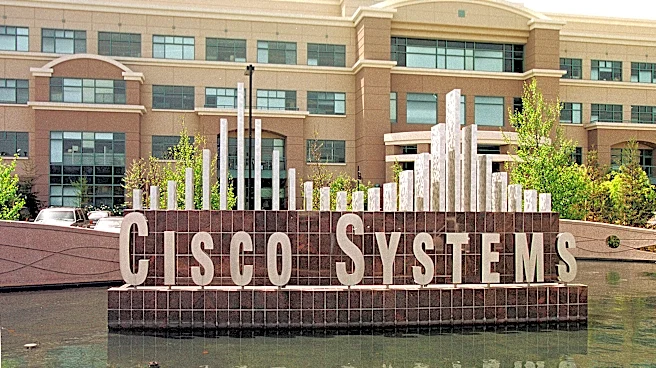
Cisco Systems (CSCO) is undertaking the corporate sector's largest enterprise-wide AI deployment, planning to issue personalized, task-executing AI agents to all approximately 90,000 employees. This rollout
is scheduled to begin in its fiscal year 2027, launching in late July/August 2026. The initiative aims to transition Cisco from experimental pilot programs to standardized, autonomous agentic workflows across various departments, including sales, engineering, finance, legal, and customer support. This significant internal AI integration comes as Cisco's share price has experienced a recent pullback, dropping 14.7% over the past month and 16.2% over the last three months, despite a 23.6% year-to-date return and a 25.8% one-year total shareholder return. The company's stock closed at $93.99, while a popular narrative on Simply Wall St suggests a fair value of $145, indicating a potential undervaluation.
Why It's Important?
This extensive AI deployment by Cisco Systems is significant as it positions the company not merely as a hardware supplier but as an AI infrastructure platform. By using its own workforce as a reference project for external clients, Cisco aims to sell blueprints for secure, agent-driven enterprises, potentially transforming its business model. The success of this internal rollout, coupled with products like AgenticOps and Cisco AI Defense, could lead to new repeatable offerings such as Secure AI Factory and silicon platforms for carriers and large corporations. For investors, the current share price pullback presents a critical juncture. While some see it as an opportunity to invest in a potentially undervalued company with strong AI prospects, the debate hinges on Cisco's ability to execute this ambitious AI strategy without cost overruns or productivity setbacks. The outcome could influence investor confidence and the company's market valuation, impacting its competitive standing in the evolving AI and cybersecurity landscape.
What's Next?
Cisco's internal AI deployment is set to commence in late July/August 2026, marking the beginning of a multi-year transition to autonomous agentic workflows across its global operations. The company will need to demonstrate successful integration and tangible benefits from this initiative to validate its strategy and potentially influence its stock performance. Investors will closely monitor the execution of this AI rollout, looking for signs of efficiency gains, cost savings, and the development of new, marketable AI-driven solutions. The market's reaction to these developments will determine whether the current share price pullback was a temporary dip or a reflection of deeper concerns regarding AI execution risk. Cisco's ability to translate its internal AI success into external product offerings will be crucial for its future growth and market perception.
Beyond the Headlines
Cisco's move to deploy AI agents to all 90,000 employees represents a pioneering step in corporate AI adoption, potentially setting a precedent for other large enterprises. This initiative raises broader questions about the future of work, the integration of AI into daily business operations, and the ethical considerations surrounding autonomous agents in the workplace. The success or challenges faced by Cisco in this endeavor could provide valuable insights into the practicalities of large-scale AI implementation, including potential impacts on employee roles, training requirements, and data security protocols. Furthermore, if Cisco successfully leverages its internal experience to create new AI infrastructure and security products, it could significantly influence the competitive landscape of the AI and cybersecurity industries, driving innovation and potentially reshaping how businesses approach digital transformation.