
What's Happening?
Wing, a drone delivery service part of Alphabet (Google's parent company), is actively seeking a Staff Machine Learning Engineer specializing in simulation for its San Francisco team. This role is crucial
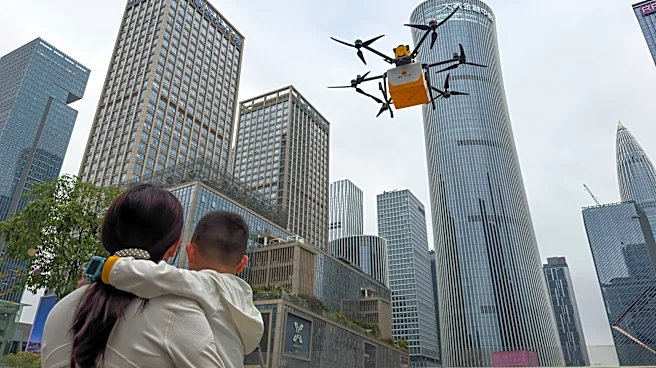
for enhancing the realism and reliability of Wing's autonomous aircraft simulations. The engineer will be responsible for designing, developing, and deploying world models and generative systems to create realistic and controllable sensor generation for large-scale simulations. This involves building high-fidelity synthetic datasets using advanced multimodal models and diffusion techniques, and integrating these with research teams across Alphabet. The position emphasizes sim-to-real efforts, ensuring that simulated models accurately reflect the behavior of physical, on-vehicle systems. Wing aims to make drone delivery a safe, fast, and sustainable solution for last-mile logistics, addressing inefficiencies, costs, and environmental impacts of current delivery methods.
Why It's Important?
This hiring initiative by Wing underscores the growing importance of advanced AI and machine learning in the development and scaling of autonomous drone technology within the U.S. The focus on simulation realism is critical for ensuring the safety and reliability of drone operations, which is a significant hurdle for widespread adoption of drone delivery services. By investing in sophisticated simulation capabilities, Wing aims to accelerate the development and testing of its autonomous systems, potentially leading to faster deployment and expansion of its drone delivery network across the country. This could transform last-mile logistics, offering businesses a more efficient and environmentally friendly delivery option, while also creating new job opportunities in high-tech fields. The success of such initiatives could set a precedent for other companies in the autonomous vehicle and delivery sectors, influencing future investment and regulatory frameworks.
What's Next?
The successful candidate for the Staff Machine Learning Engineer role will play a pivotal part in shaping Wing's AI infrastructure, establishing best practices for large-scale training, and championing foundational AI initiatives. This strategic hire is expected to significantly advance Wing's simulation capabilities, which are essential for the continuous improvement and expansion of its drone delivery services. As Wing refines its autonomous systems through enhanced simulation, it is likely to pursue further regulatory approvals and partnerships to broaden its operational footprint in the U.S. and potentially other markets. The company's long-term goal is to establish drone delivery as the preferred means of delivery globally, and this role is a key step in achieving that vision by ensuring the robustness and safety of its technology.
Beyond the Headlines
The push for highly realistic simulations in drone technology, as evidenced by Wing's hiring, highlights a broader trend in autonomous systems development: the increasing reliance on virtual environments to test and validate complex AI models. This approach not only reduces the cost and time associated with physical testing but also allows for the exploration of rare and dangerous scenarios that would be impractical or unsafe to replicate in the real world. The ethical implications of deploying highly autonomous systems, particularly in public spaces, necessitate rigorous testing and validation, which advanced simulation provides. Furthermore, the integration of AI and machine learning in drone operations raises questions about data privacy, airspace management, and the potential impact on traditional logistics jobs. Wing's efforts in this area could influence public perception and regulatory attitudes towards autonomous drone technology, shaping its future integration into daily life.