







What's Happening?
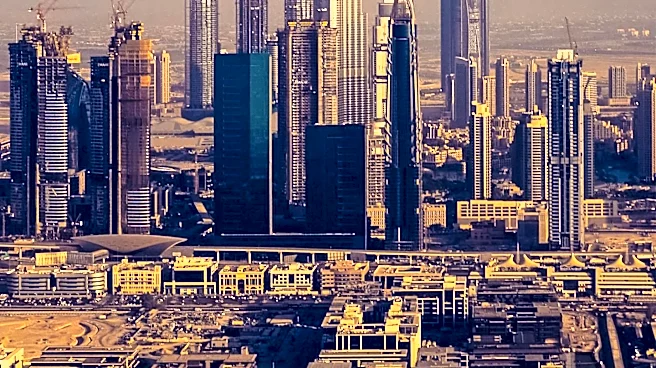
Adrian Smith, an architect from Chicago-based Skidmore, Owings & Merrill, is recognized for designing the Burj Khalifa in Dubai. Completed between 2004 and 2010 and officially opened on January 4, 2010, the Burj Khalifa stands as the world's tallest building,
reaching an architectural height of 828 meters (2,717 feet). The mixed-use skyscraper functions as a vertical city, incorporating hotel, residential, and office spaces across its 163 occupied floors. Its design features a three-winged plan radiating from a central core, which provides structural stability and offers extensive outward views. The building's construction involved high-strength concrete for the lower sections and steel for the upper portions, with a tapering design and setbacks to manage wind effects at high altitudes. The Council on Tall Buildings and Urban Habitat certified its status as the world's tallest building after reviewing detailed architectural drawings.
Why It's Important?
The Burj Khalifa's design by Adrian Smith significantly redefined expectations for commercial, residential, and hospitality buildings in the 21st century. Its unprecedented height and mixed-use functionality demonstrate advanced architectural and engineering capabilities, pushing the boundaries of skyscraper design. The project showcases how extreme height can be integrated into a functional 'vertical city,' offering a model for urban development in dense metropolitan areas. This achievement highlights the innovative potential within the architecture and construction industries, particularly in creating structures that serve multiple purposes and contribute to a city's skyline and economic landscape. The success of such a monumental project can inspire future developments and influence global architectural trends, impacting how urban spaces are conceived and built worldwide.
What's Next?
While the Burj Khalifa is already completed, its enduring legacy as a landmark designed by Adrian Smith continues to influence contemporary architecture. The principles of mixed-use development and extreme height engineering demonstrated in the Burj Khalifa are likely to be further explored and refined in future projects globally. Architects and developers may draw inspiration from its structural innovations and integrated urban planning approach for upcoming supertall structures. Adrian Smith + Gordon Gill Architecture, the firm associated with Smith, continues to be involved in significant mixed-use developments, suggesting a continued focus on large-scale, innovative architectural solutions. This ongoing work will likely build upon the lessons learned from the Burj Khalifa, potentially leading to new advancements in sustainable and efficient high-rise construction.
Beyond the Headlines
The Burj Khalifa, designed by Adrian Smith, represents more than just a tall building; it symbolizes human ambition and technological prowess in overcoming engineering challenges. Its construction in the desert climate of Dubai required innovative solutions for materials, wind resistance, and vertical transportation, pushing the limits of what was previously thought possible. The building's status as a global icon also has cultural implications, attracting tourism and serving as a powerful symbol of Dubai's rapid development and modernization. Ethically, such projects raise questions about resource allocation, environmental impact, and the social dynamics of creating vertical communities. The long-term shifts triggered by this development include a global competition for the tallest structures and a re-evaluation of urban density and mixed-use integration in city planning.