






What's Happening?
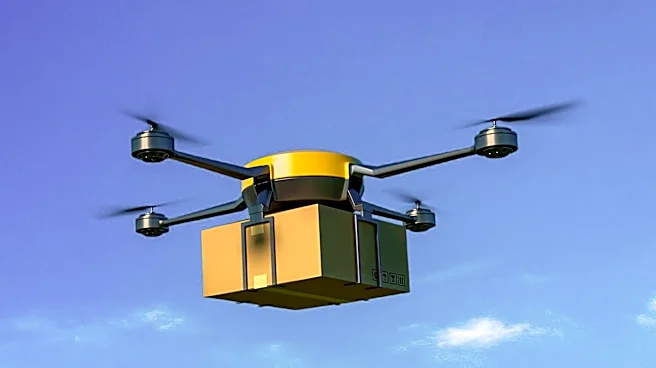
An Amazon Prime Air MK30 drone, designed to deliver packages up to five pounds, crashed into a neighbor's garage in Huntington Woods, Michigan, after delivering shampoo. According to the Federal Aviation Administration's (FAA) preliminary account, the drone struck
a fiber-optic cable during its ascent, lost a propeller, and became entangled in power lines before impacting the garage. This incident, which occurred in November 2026, resulted in temporary power loss for the home and minor damage to the garage roof. No injuries were reported. This crash is the latest in a series of incidents involving Amazon's delivery drones, including two MK30 drones hitting a construction crane in Tolleson, Arizona, in October 2025, another clipping an internet cable in Waco, Texas, in November 2025, and a drone making contact with an apartment building in Richardson, Texas, in February 2026. The FAA has confirmed an active investigation into the Michigan crash.
Why It's Important?
The recurring incidents involving Amazon's Prime Air drones highlight significant challenges for the broader drone delivery industry in the U.S. While companies like Amazon are pushing for expansion, these crashes raise concerns about safety, reliability, and the integration of drone operations into existing infrastructure. The FAA's ongoing investigations underscore the regulatory scrutiny faced by drone delivery services. Public acceptance is also a critical factor, as residents in areas with drone operations have expressed concerns about noise and safety, particularly after incidents like the one in Michigan. The ability of drone delivery services to scale effectively depends not only on technological advancements but also on addressing these safety and community concerns, which could influence future regulatory frameworks and public perception of drone delivery as a viable and safe option.
What's Next?
The FAA's investigation into the Michigan drone crash is ongoing, and the National Transportation Safety Board (NTSB) is gathering information to determine if it will launch its own inquiry. Amazon, which currently operates from 11 U.S. hubs, had announced plans in August to expand its Prime Air service to nearly 500 U.S. cities and towns by the end of the year. However, these recent incidents could lead to increased regulatory pressure and potentially slow down the planned expansion. The drone industry has been advocating for a more standardized framework for drone operations, and the FAA proposed new rules in 2025 to simplify the approval process for routine beyond-visual-line-of-sight (BVLOS) flights. The outcome of these investigations and the effectiveness of the proposed regulations will be crucial in determining the future trajectory and widespread adoption of drone delivery services in the U.S.
Beyond the Headlines
The challenges faced by Amazon's Prime Air service extend beyond individual crashes, touching upon fundamental issues of urban planning, airspace management, and public policy. The incidents underscore the complex interplay between emerging technologies and existing urban environments, particularly in densely populated areas with overhead wires and buildings. The debate over drone noise and privacy concerns also highlights a broader societal discussion about the integration of autonomous technologies into daily life. As drone delivery services aim for widespread adoption, there will be increasing pressure to develop robust traffic management systems for drones, similar to those for traditional aircraft, to prevent collisions and ensure safe operation. The long-term success of drone delivery will likely depend on a collaborative effort between technology companies, regulatory bodies, and local communities to address these multifaceted challenges and build public trust.