





What's Happening?
Cleveland-Cliffs Inc., the largest flat-rolled steel producer in North America, is closely monitoring industrial demand trends driven by electrification and the expansion of data centers. The company, which has transformed from an iron ore miner into
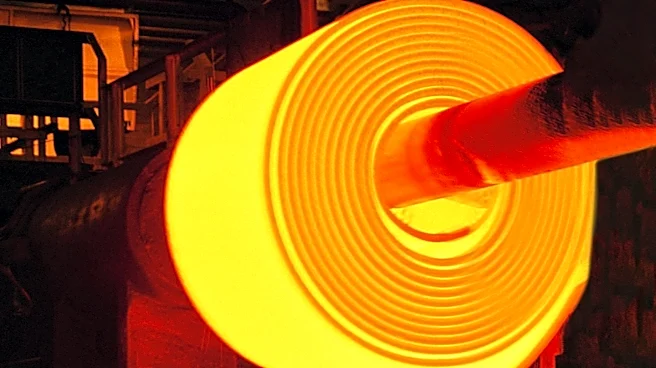
a vertically integrated steelmaker, supplies various sectors including automotive, construction, and the power grid. Its operations span from mining raw materials to primary steelmaking and downstream finishing. A significant aspect of its business is the production of specialized electrical steel, essential for transformers used in power and distribution. The broader market has seen volatility, with industrial materials gaining attention as investors seek companies tied to physical activity rather than software. Cleveland-Cliffs' ability to adapt to market swings and manage its extensive network of mills, finishing lines, and mines is a central operational challenge. The company's stock price recently saw a slight decrease, reflecting the dynamic market conditions.
Why It's Important?
The performance of Cleveland-Cliffs is a key indicator for the U.S. industrial sector, as steel remains a foundational material for modern construction, transportation, and manufacturing. The company's vertical integration provides stability by controlling its raw material supply, a crucial advantage over mills reliant on external suppliers. The rising demand for electrification infrastructure, such as wind towers, solar mounting structures, and data center frames, directly benefits Cleveland-Cliffs, creating a new thread of demand that complements traditional sources. As the sole domestic producer of grain-oriented electrical steel, the company plays a critical role in addressing transformer shortages, which are bottlenecks for utilities and developers. This niche positioning allows Cleveland-Cliffs to capitalize on grid upgrades and the proliferation of data center campuses, directly impacting the nation's energy infrastructure and technological expansion. The company's significant role in the automotive industry also means its performance is closely tied to vehicle production schedules, influencing a major segment of the U.S. economy.
What's Next?
Upcoming bank earnings reports are expected to offer insights into the health of the manufacturing and construction sectors, which will provide clues for Cleveland-Cliffs' future performance. Following this, the steel group will release its own results, with market attention focused on shipment volumes, realized prices, unit costs, and the trajectory of electrical steel and automotive demand. Discussions regarding trade measures will remain a central theme, as changes in tariffs or quotas can significantly alter the competitive landscape for domestic producers. Updates on order books for infrastructure and grid projects, particularly how data center construction translates into demand for structural and electrical steel, will be of particular interest. The company's ability to efficiently manage its operations amidst fluctuating market conditions and global competition will be crucial in determining its short-term outlook.
Beyond the Headlines
Cleveland-Cliffs' position at the intersection of traditional industry and new infrastructure highlights broader economic shifts in the U.S. The company's reliance on blast furnaces and direct-reduced iron, while offering deep integration, also entails heavier fixed costs compared to electric-arc furnace operators. This structural difference shapes its behavior through economic cycles and underscores the capital-intensive nature of foundational industries. The ongoing tension between open trade and support for local mills, particularly concerning steel imports, reflects a persistent debate in U.S. economic policy. The company's outspoken support for strong enforcement against unfair trade practices illustrates the significant impact of trade measures on domestic producers. Furthermore, the demand for specialized electrical steel for transformers points to a critical, often overlooked, component of the nation's energy transition and digital infrastructure build-out, revealing the intricate dependencies within the modern economy.