







What's Happening?
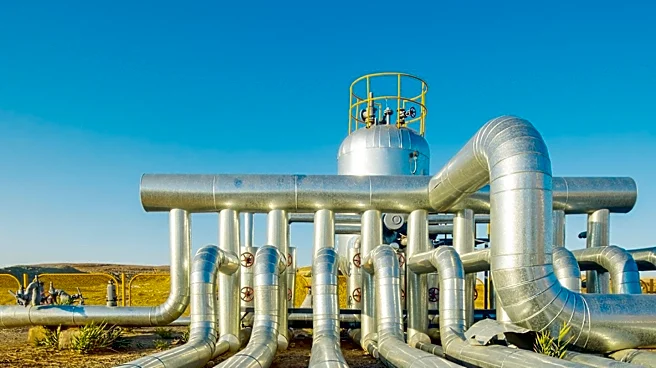
Kinder Morgan has announced final investment decisions for two significant natural gas pipeline projects, the Southeast Connector and Permian Link, representing a combined direct investment of $4.7 billion for the company and over $7 billion in total
infrastructure costs. The Southeast Connector, a Southern Natural Gas (SNG) project, will span approximately 470 miles with a capacity of up to 2.6 billion cubic feet per day (bcfd) and is valued at $3.1 billion. The Permian Link, sanctioned through Natural Gas Pipeline Co. of America (NGPL), is larger at 434 miles and 2.8 bcfd capacity, with a total estimated cost of $4.2 billion. Both projects are supported by long-term, take-or-pay transportation agreements with shippers, including a major hyperscaler. Service for the Southeast Connector is expected to begin in phases starting in Q4 2030, while NGPL targets a Q3 2030 in-service date for the Permian Link, both pending permits and approvals. These investments are driven by a significant increase in electricity demand, particularly from the power sector and large-scale data center operators.
Why It's Important?
This substantial investment by Kinder Morgan underscores a strong market confidence in the sustained demand for natural gas, especially for power generation in the U.S. The projects are directly linked to the surging electricity demand, with large-load interconnection requests in the Southeast exceeding 200 gigawatts. The involvement of a major hyperscaler in contracting for the Permian Link explicitly connects the growth of artificial intelligence infrastructure to the need for new natural gas pipeline construction. This indicates that the expansion of data centers and AI technologies is a significant driver for energy infrastructure development. The long-term, take-or-pay contracts backing these pipelines mitigate revenue risk for Kinder Morgan and signal that shippers are making equally long-term commitments to natural gas as a reliable energy source. This could lead to increased energy security and stability for regions served by these pipelines, supporting economic growth and technological advancements.
What's Next?
Kinder Morgan anticipates the Southeast Connector to begin service in phases starting in Q4 2030, and the Permian Link in Q3 2030, both contingent on obtaining necessary permits and approvals. The company has also sanctioned phases two and three of its Creekside Lateral project, with service expected from Q4 2026 through Q4 2027, and is advancing other infrastructure projects, including the Bear Creek Storage Expansion (expected April 2029), pipelines connecting its Pasadena Terminal to a refinery (expected Q3 2027), and an expansion of the Kinder Morgan Export Terminal (expected Q1 2027). These projects collectively indicate a continued expansion of natural gas infrastructure to meet growing demand, particularly from the power sector and data centers. The company's strong Q3 2026 earnings and record throughput at the Houston Ship Channel suggest a robust financial position to execute these plans, reinforcing its role in the U.S. energy landscape.
Beyond the Headlines
The significant investment in natural gas pipelines by Kinder Morgan highlights a broader trend where the rapid expansion of digital infrastructure, particularly data centers fueled by artificial intelligence, is directly impacting traditional energy sectors. While the focus is on natural gas, this development could intensify debates around energy policy, environmental concerns, and the transition to renewable energy sources. The reliance on natural gas for AI infrastructure raises questions about the long-term sustainability of such growth and the potential for increased carbon emissions, even as the industry seeks to optimize efficiency. This also points to the complex interplay between technological advancement and energy consumption, suggesting that the energy demands of the digital age will continue to shape infrastructure development and potentially influence regulatory frameworks and investment priorities in the coming years.