


What's Happening?
Fisker Inc., an electric vehicle manufacturer, has finalized its bankruptcy proceedings in Sweden and Norway, resulting in significantly lower compensation for vehicle owners and creditors than anticipated. In Sweden, the total value of Fisker's assets
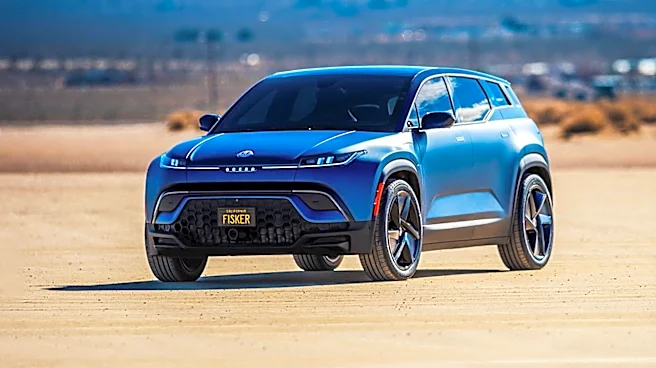
was estimated at approximately 6 million Swedish kronor ($632,000). After prioritizing payments to secured creditors, only 2.5 million kronor ($263,000) was distributed among car owners who agreed to a settlement. This translates to roughly 41,000 kronor ($4,300) per owner, a stark contrast to the 147,800 kronor ($15,500) they initially sought to cover warranty issues and missing parts. Legal fees in Sweden alone amounted to 3.4 million kronor ($356,000), exceeding the total compensation for owners. The situation in Norway was even more severe, with Fisker's local debts totaling 620 million kronor ($66.33 million), including 457 million kronor ($48.8 million) owed to Magna Steyr, the manufacturer of the Fisker Ocean SUV. This marks the second bankruptcy for Henrik Fisker, whose previous venture, Fisker Automotive, also failed in 2013.
Why It's Important?
The financial collapse of Fisker Inc. and the subsequent minimal compensation for its customers highlight the inherent risks and challenges within the burgeoning electric vehicle market. For consumers, this event underscores the importance of scrutinizing the financial stability and long-term viability of new automotive brands, particularly those in the EV sector which often operate with significant capital expenditure and uncertain profitability. The substantial legal fees in comparison to customer payouts also raise questions about the efficiency and fairness of bankruptcy processes, potentially eroding consumer trust in emerging companies. For the broader automotive industry, Fisker's struggles serve as a cautionary tale, emphasizing that innovative product design alone is insufficient without robust financial management and a sustainable business model. This situation could lead to increased skepticism from investors and consumers towards new EV startups, potentially consolidating market power among established manufacturers with deeper pockets and proven track records.
What's Next?
While Fisker Inc. has completed its bankruptcy proceedings in Sweden and Norway, the long-term implications for affected customers and the broader EV market are still unfolding. Owners of Fisker Ocean vehicles, particularly in the U.S., may continue to face challenges regarding warranty claims, spare parts, and vehicle servicing. The Fisker Owners Association has emerged as a community-driven support network, crowdsourcing repair instructions to help maintain vehicles. Furthermore, the acquisition of the Fisker Ocean's software code by American Lease in 2024 suggests that the vehicle may continue to receive software updates, offering a glimmer of hope for the operational longevity of existing cars. However, the lack of a direct manufacturer will likely complicate future support and resale values. This event could also prompt regulatory bodies to consider stricter oversight or consumer protection measures for new automotive companies, especially those in high-growth, high-risk sectors like electric vehicles, to prevent similar outcomes for future customers.
Beyond the Headlines
The repeated failure of Henrik Fisker's automotive ventures, first with Fisker Automotive and now Fisker Inc., points to a deeper systemic challenge in transforming ambitious electric vehicle concepts into sustainable commercial successes. This pattern suggests that the vision and design prowess, while crucial, are not enough to navigate the complex landscape of automotive manufacturing, supply chain management, and post-sales support. The story of Fisker Inc. also highlights the precarious position of early adopters in innovative markets; their enthusiasm and investment often bear the brunt of corporate failures. The reliance on community-driven solutions, such as the Fisker Owners Association, to maintain vehicles post-bankruptcy, underscores a growing trend of consumer self-reliance in the face of corporate collapse, raising questions about manufacturer responsibility and the durability of product ecosystems in a rapidly evolving technological landscape. This case could influence future investment strategies in the EV sector, favoring companies with more robust financial backing and established manufacturing capabilities.