



What's Happening?
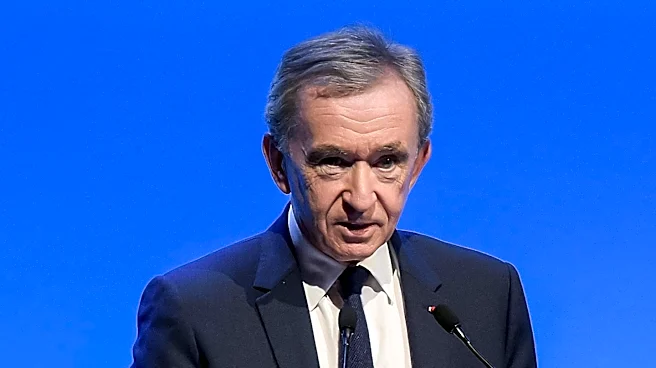
Bernard Arnault, the 77-year-old chairman and chief executive of LVMH, has extended his retirement age to 95, allowing him to lead the luxury conglomerate for an additional 18 years. This change, revealed in company filings in Paris, is part of a broader
corporate restructuring aimed at solidifying his family's control over the business. The new age limit applies to his role as managing general partner of Agache SCA, the family-owned holding company that controls LVMH. This move enables Arnault to maintain effective control of the group until 2044. The restructuring also involves merging the Arnault family's investment vehicle, Agache, with another LVMH holding company, Christian Dior SE. The resulting single entity will own just under 50% of LVMH shares but will control 66.55% of the voting rights, streamlining the family's corporate structure and ensuring multi-generational oversight.
Why It's Important?
This decision by Bernard Arnault has significant implications for the global luxury market and corporate governance. By extending his leadership for nearly two more decades, Arnault ensures continuity and stability for LVMH, a powerhouse that owns over 70 luxury brands, including Louis Vuitton, Christian Dior, and Tiffany. This move reinforces the trend of founder-led companies maintaining long-term control, potentially delaying succession planning and the integration of new leadership perspectives. For U.S. consumers and the luxury retail sector, this means a consistent strategic direction for brands with a substantial presence in the American market. The increased family control through enhanced voting rights also signals a strong commitment to a long-term vision, potentially prioritizing brand heritage and strategic acquisitions over short-term shareholder pressures. Competitors in the luxury space will be watching closely, as LVMH's sustained leadership under Arnault could further entrench its dominant market position.
What's Next?
With Bernard Arnault set to remain at the helm until 2044, the immediate future for LVMH will likely see a continuation of its established strategies: strategic acquisitions, brand development, and international expansion. The streamlined corporate structure is expected to facilitate more agile decision-making within the family's control. While Arnault's 49-year-old son, Antoine, currently holds a chief executive position with a 10-year lower age limit, this extension for Bernard Arnault suggests a prolonged period of mentorship and preparation for future leadership. The market will be observing how this extended tenure impacts LVMH's innovation pipeline, its response to evolving consumer preferences, and its competitive positioning against other luxury conglomerates. The move also sets a precedent for other family-controlled businesses, potentially influencing their long-term governance and succession planning strategies.
Beyond the Headlines
The extension of Bernard Arnault's leadership to age 95 highlights a broader discussion about corporate longevity and the role of founding families in modern business. This decision underscores the unique dynamics of luxury conglomerates, where brand heritage and long-term vision often outweigh conventional corporate governance norms regarding executive age limits. It raises questions about the balance between experienced leadership and the need for fresh perspectives and innovation in a rapidly changing global market. While ensuring stability, such extended tenures can also spark debates about succession planning, potential entrenchment, and the impact on younger generations within the company. The move also reflects a cultural aspect of European family-owned businesses, where multi-generational control is often a core value, contrasting with some U.S. corporate structures that emphasize more frequent leadership transitions.