






What's Happening?
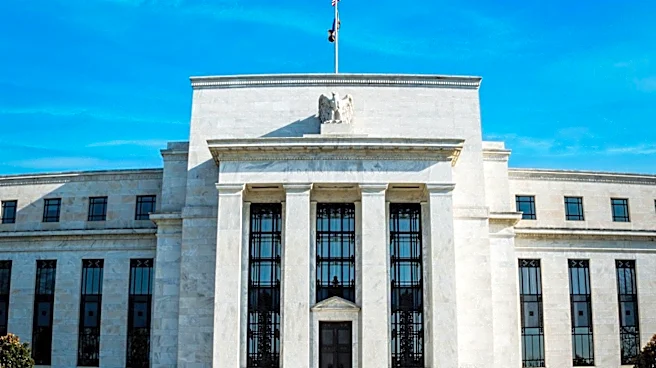
As of late 2026, the Federal Reserve has maintained its interest rates at 3.75–4.00 percent. This decision reflects a continued restrictive monetary policy in the United States, driven by several key domestic economic factors. The U.S. economy has demonstrated
resilient consumption patterns and strong investment, contributing to persistent price pressures. This contrasts with the more varied approaches taken by other major central banks globally, which are implementing differentiated policies based on their unique inflation, growth, and financial stability conditions. For instance, the European Central Bank held rates at 2.50 percent, the Bank of England at 4.00 percent, and the Bank of Japan at 1.25 percent, while China pursued targeted easing. The Fed's current stance indicates its focus on managing domestic inflationary pressures despite global monetary policy shifts.
Why It's Important?
The Federal Reserve's decision to maintain a restrictive interest rate stance has significant implications for the U.S. economy and global financial markets. Domestically, it signals the Fed's commitment to curbing inflation, potentially impacting borrowing costs for consumers and businesses, and influencing investment decisions. For U.S. industries, higher interest rates can increase the cost of capital, potentially slowing expansion but also cooling an overheated economy. Globally, while the Fed's actions continue to influence international yields, capital flows, and exchange rates, the current environment shows a move away from uniform synchronization. Other central banks are increasingly prioritizing their domestic economic realities, meaning the Fed's influence, while still substantial, is now part of a more complex global monetary landscape. This differentiation suggests that U.S. economic policy is increasingly charting its own course based on internal conditions, rather than acting as a sole global conductor.
What's Next?
The Federal Reserve is expected to continue monitoring U.S. economic indicators closely, particularly consumption, investment, and inflation data, to determine future monetary policy adjustments. Given the current resilient consumption and strong investment, the Fed may maintain its restrictive stance for the foreseeable future if price pressures persist. However, any significant shifts in these domestic economic factors could prompt a re-evaluation of interest rate policy. The divergence in monetary policies among global central banks suggests that the Fed's future decisions will be primarily driven by U.S. economic performance rather than a need to align with international trends. Stakeholders, including businesses and investors, will be closely watching for any signals regarding potential rate changes, which could impact credit markets, corporate earnings, and consumer spending.
Beyond the Headlines
The Federal Reserve's sustained restrictive policy highlights a broader shift in global monetary dynamics, where domestic economic realities are increasingly dictating central bank decisions. This move away from a synchronized global monetary policy, once largely dictated by the Fed, underscores the growing complexity of the international economic environment. It suggests that while the U.S. dollar remains central to global finance, other nations are asserting greater monetary independence to address their unique challenges, such as energy costs in Europe or subdued demand in China. This differentiation could lead to more varied economic outcomes across regions and potentially increase volatility in currency markets as interest rate differentials widen. For the U.S., it means the Fed has more autonomy to focus solely on its dual mandate of maximum employment and price stability, potentially leading to more tailored and effective domestic economic management.