





What's Happening?
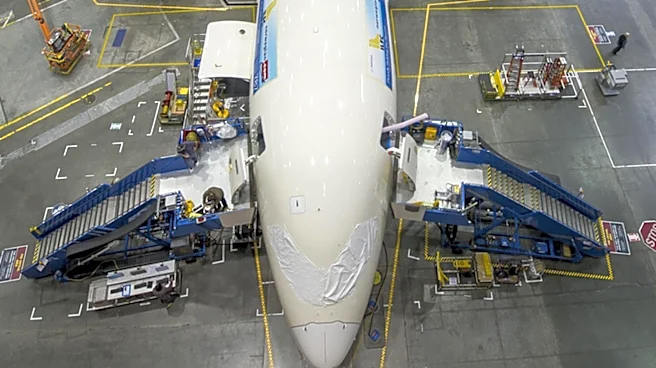
Northrop Grumman Chief Executive Kathy Warden announced plans for significant investments in manufacturing capacity to increase the production of the B-21 Raider bomber. These investments are expected to continue through 2028, with a subsequent increase in output
later in the decade. Warden stated that the company anticipates higher B-21 production rates and that sustainment and modernization work will also contribute to the program's growth. Chief Financial Officer John Greene indicated that companywide capital expenditures are projected to be approximately $2.1 billion in 2027, representing about 4.5% of sales, with a portion dedicated to supporting the higher B-21 production rate.
Why It's Important?
The expansion of B-21 Raider bomber production capacity is critical for the U.S. Air Force's modernization efforts and national security. The B-21 is a key component of the nation's long-range strike capabilities, and increasing its production ensures the timely delivery of these advanced aircraft. This investment by Northrop Grumman highlights the company's commitment to meeting defense requirements and its role as a major defense contractor. The capital expenditures, while substantial, are expected to be offset by stronger operating performance, working capital management, and tax optimization, maintaining a forecast for adjusted free cash flow of $3.3 billion to $3.7 billion in 2027. This strategic move reinforces the U.S. defense industrial base and its ability to deliver cutting-edge military technology.
What's Next?
Northrop Grumman expects B-21 testing and production to intensify in 2027, alongside continued investments in long-term expansion. The company is also developing sustainment and modernization efforts for the aircraft. While the program is performing well in testing, Chief Executive Kathy Warden acknowledged that risks remain as Northrop completes its outstanding low-rate initial production aircraft. The increasing share of B-21 sales is anticipated to support further growth in the Aeronautics Systems business in 2027, though it may exert some pressure on the division's operating margin. The successful execution of these expansion plans will be crucial for both Northrop Grumman's financial performance and the U.S. military's strategic objectives.
Beyond the Headlines
The B-21 Raider program represents a significant technological leap in stealth bomber capabilities, designed to operate in highly contested environments. The decision to expand production capacity underscores the urgency and strategic importance of this asset in future defense scenarios. This investment also reflects the broader trend of increasing defense spending and the continuous need for advanced military hardware to maintain a technological edge. The challenges of managing fixed-price, low-rate initial production contracts, as mentioned by Warden, highlight the complexities and financial risks inherent in large-scale defense projects. The success of the B-21 program will not only impact Northrop Grumman but also influence future defense procurement strategies and the competitive landscape of the aerospace and defense industry.