







What's Happening?
Michael Burry, known for 'The Big Short,' has issued a warning that five major hyperscalers—Amazon, Meta Platforms, Alphabet, Microsoft, and Oracle—are concealing over $3 trillion in largely off-balance-sheet liabilities related to artificial intelligence
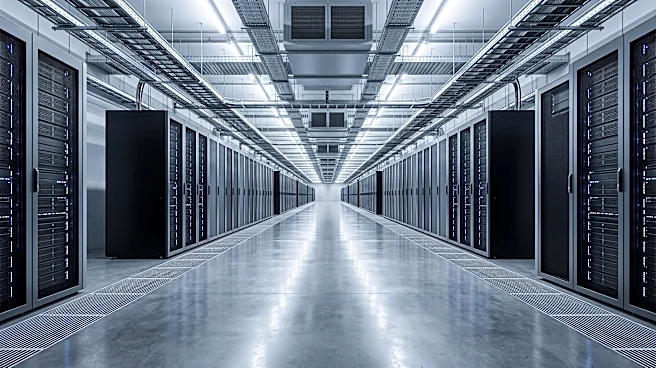
(AI). Burry estimates these companies have nearly $1.2 trillion in uncommenced lease commitments and more than $1.5 trillion in purchase commitments. When including special-purpose vehicles, guarantees, and other obligations, the total exceeds $3 trillion. He argues that these liabilities are in 'hypergrowth mode,' expanding faster than the companies themselves, and that Wall Street is not adequately modeling these risks in stock projections. Burry's central concern is the mismatch between the long lifespan of data center infrastructure and the rapid pace of AI chip development, which could leave hyperscalers with expensive, specialized facilities that are difficult to repurpose if AI demand shifts or chip architectures change.
Why It's Important?
This warning is significant for the U.S. business and financial sectors, as it highlights potential systemic risks within the booming AI industry. If Burry's assessment is accurate, the underestimation of these liabilities could lead to substantial financial repercussions for the involved hyperscalers and their investors. Wall Street's current bullish outlook on AI infrastructure spending, projected to reach $1 trillion, may be overlooking critical vulnerabilities. The rapid obsolescence of AI hardware, coupled with long-term data center commitments, could result in stranded assets and significant write-downs, impacting company valuations and potentially triggering broader market instability. This situation could affect institutional investors, pension funds, and individual shareholders who are heavily invested in these tech giants, leading to a re-evaluation of investment strategies and risk assessments within the technology sector.
What's Next?
Following Burry's warning, there may be increased scrutiny from financial analysts and investors into the balance sheets and off-balance-sheet commitments of major hyperscalers. Companies might face pressure to provide more transparent disclosures regarding their AI-related infrastructure investments and potential liabilities. Regulators could also take an interest in these claims, potentially leading to new reporting requirements or investigations into accounting practices within the tech industry. The market's reaction will depend on whether Burry's concerns gain traction among a wider audience of financial experts. If his predictions materialize, it could lead to a re-pricing of tech stocks, particularly those of companies heavily invested in AI infrastructure, and a shift in investment capital towards more conservatively valued assets or sectors. The ongoing rapid development of AI technology will continue to challenge companies to balance innovation with financial prudence.
Beyond the Headlines
Beyond the immediate financial implications, Burry's warning raises deeper questions about the sustainability of rapid technological growth and the potential for speculative bubbles in emerging industries. The 'move fast and break things' ethos, often associated with tech innovation, may be encountering its financial limits when applied to massive, long-term infrastructure investments. This situation could prompt a re-evaluation of how technological advancements are financed and how risks are assessed in high-growth sectors. It also highlights the challenge of accounting for rapidly evolving technology, where the economic depreciation of hardware can outpace traditional GAAP depreciation methods. The potential for 'stranded assets' in the form of specialized data centers could lead to a more cautious approach to capital expenditure in the tech industry, emphasizing modularity and adaptability over sheer scale, and potentially influencing the future trajectory of AI development and deployment.