






What's Happening?
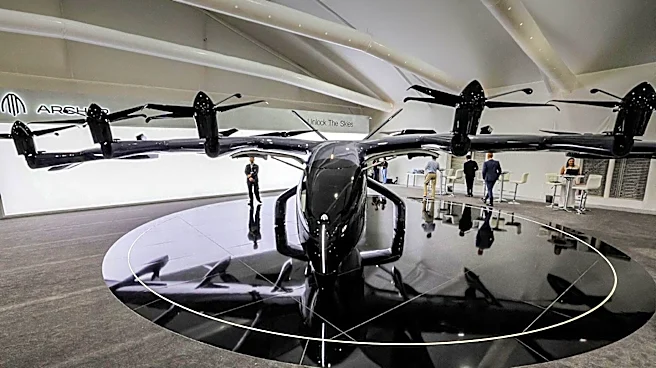
Archer Aviation is actively developing electric vertical takeoff and landing (eVTOL) aircraft, with a primary focus on establishing urban air taxi services and exploring defense applications. The company has secured a conditional purchase agreement with United
Airlines for its Midnight aircraft, which is contingent upon receiving FAA certification and finalizing contractual terms. Archer Aviation is also engaged in strategic collaborations with the U.S. Air Force, Stellantis, and Boeing Co. To bolster its defense segment, Archer Aviation has acquired several subsidiaries. The company is progressing towards the commercialization of its eVTOL aircraft, including the refurbishment of Hawthorne airport in Los Angeles for testing purposes and scaling up its manufacturing capabilities to produce 50 aircraft annually. Archer Aviation's overarching goal is to offer quiet, emission-free flights as an alternative to lengthy car commutes, initially targeting major metropolitan areas. Financial analysts project that Archer will achieve its first profit in 2030, with an estimated revenue of $2.3 billion, though significant regulatory and operational challenges remain.
Why It's Important?
The development and commercialization efforts by Archer Aviation are significant for the U.S. transportation industry and urban planning. The introduction of eVTOL aircraft for urban air mobility could revolutionize how people commute in congested metropolitan areas, potentially reducing travel times and offering a more sustainable transportation option. This initiative could create new economic opportunities in manufacturing, infrastructure development (such as vertiports), and specialized aviation services. The collaboration with the U.S. Air Force also highlights the potential dual-use nature of this technology, indicating future applications in defense and national security. However, the success of Archer Aviation and the broader urban air mobility sector hinges on overcoming substantial regulatory hurdles, including FAA certification, and addressing public acceptance and infrastructure requirements. The projected profitability in 2030 suggests a long-term investment horizon, with early investors and partners taking on considerable risk in a nascent industry.
What's Next?
Archer Aviation's immediate next steps involve securing FAA certification for its Midnight aircraft, which is crucial for fulfilling its conditional purchase agreement with United Airlines and commencing commercial operations. The company will continue its efforts to refurbish Hawthorne airport for testing and further scale up its manufacturing capacity to meet the target of 50 aircraft per year. Continued collaboration with partners like the U.S. Air Force, Stellantis, and Boeing Co. will be essential for technological advancements and market penetration. The company will also need to navigate the complex regulatory landscape and work with urban planners to establish the necessary infrastructure for vertiports and air traffic management in target metropolitan areas. Public outreach and education will be vital to build trust and acceptance for urban air taxi services. The financial projections for profitability in 2030 indicate a sustained period of investment and development before significant returns are expected.
Beyond the Headlines
Beyond the immediate operational and financial aspects, Archer Aviation's endeavors in urban air mobility could trigger profound shifts in urban development and societal norms. The widespread adoption of air taxis could lead to a re-evaluation of urban infrastructure, potentially reducing reliance on traditional road networks and influencing real estate development around vertiports. Environmentally, the promise of emission-free flights aligns with broader sustainability goals, offering a cleaner alternative to fossil fuel-powered transportation. However, the ethical implications of increased air traffic, noise pollution in urban environments, and equitable access to such services will need careful consideration. The long-term success of this technology will depend not only on its technical viability and safety but also on its integration into the existing social and regulatory fabric, potentially reshaping our understanding of urban living and connectivity.