




What's Happening?
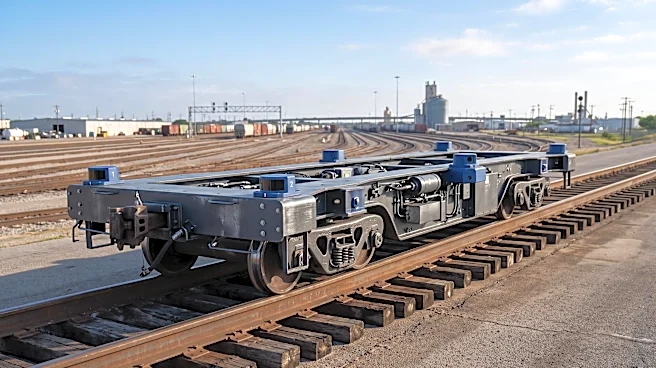
Intramotev, a Missouri-based startup, is advancing its mission to replace diesel-powered locomotives with zero-emission, autonomous electric railcars. The company's 'TugVolt' system allows railcars to operate independently or as switchers, ferrying conventional
railcars. A significant development includes a $16.3 million grant from the Federal Railroad Administration (FRA), a branch of the U.S. Department of Transportation. This grant will support a project hosted by the Columbia Terminal Railroad in Missouri, aiming to deploy autonomous railcars to establish a safety record and create a workforce training curriculum. Intramotev has also expanded its U.S. footprint with an agreement in Texas with Watco, a short line railway holding company, for TugVolt to perform zero-emission switcher duties. Additionally, the company lent a TugVolt to a U.S. Army Reserve Training exercise in Mississippi, where soldiers trained on the system.
Why It's Important?
This initiative is crucial for the decarbonization of the U.S. rail freight system and has broader implications for reducing highway freight emissions. By electrifying short line routes and enabling autonomous operation, Intramotev's technology can significantly decrease reliance on diesel fuel, contributing to environmental goals. The federal grant underscores a policy push to integrate electric vehicles into the national railway system, potentially setting a precedent for future infrastructure modernization. The deployment of autonomous railcars could also address the ongoing driver shortage in the trucking industry by shifting more freight to rails. Furthermore, the Army's engagement with TugVolt suggests a potential for military adoption of EV technology, which could enhance operational efficiency and reduce logistical complexities associated with traditional rail crews.
What's Next?
The FRA's selection of the Missouri project for development, final design, and construction indicates that the TugVolt will begin running on the Columbia Terminal Railroad in the future, following further steps in the process. This project is expected to produce the first documented safety record for autonomous railcar operation and will lead to the creation of a workforce training curriculum. Intramotev's expanded relationship with Watco in Texas will see TugVolt deployed for switcher duty at an industrial facility in Seadrift. The company also has a forthcoming agreement in Kentucky, further extending its U.S. presence. Internationally, Intramotev's TugVolt technology has already been deployed in Austria with the national railway ÖBB, suggesting potential for broader global adoption and further technological advancements.
Beyond the Headlines
The shift towards autonomous electric railcars represents a fundamental change in freight logistics, moving beyond mere electrification to embrace automation. This could lead to a more efficient, flexible, and environmentally sustainable transportation network. The development of a documented safety record for autonomous railcar operation, supported by federal funding, is critical for establishing trust and regulatory frameworks for this emerging technology. The involvement of the U.S. Army Reserve highlights the dual-use potential of such innovations, where commercial advancements can also serve national defense needs, potentially streamlining military logistics. This convergence of environmental, economic, and strategic interests could accelerate the adoption of autonomous EV rail technology, reshaping the future of freight movement in the U.S. and beyond.