






What's Happening?
Conor Niland's memoir, 'The Racket: On Tour with Tennis's Golden Generation and the Other 99%', delves into the often-unseen financial and psychological struggles faced by professional tennis players outside the sport's top echelon. Niland, who achieved
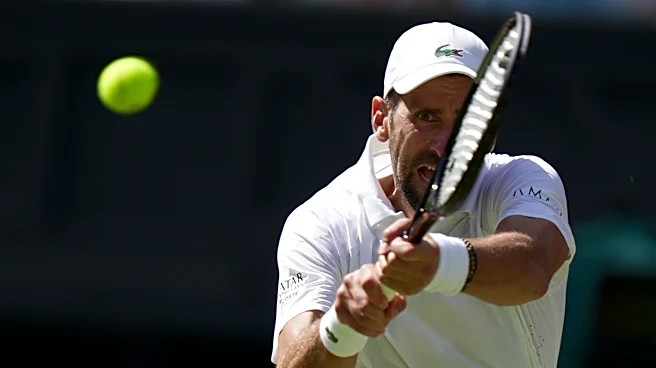
a career-high ranking of 129, highlights that despite this extraordinary achievement, financial security was elusive. He details the significant personal costs involved in touring, including self-funding travel, accommodation, coaching, and medical treatment, often before earning substantial prize money. The book reveals that his career prize money of just under a quarter of a million dollars was largely consumed by expenses over several years. Niland's experience underscores the disparity between the glamorous image of professional tennis and the harsh realities for the vast majority of players. He recounts instances of logistical challenges, such as misreading itineraries and boarding wrong trains, and the constant pressure to perform while dealing with physical and mental strain, including food poisoning during a US Open match against Novak Djokovic.
Why It's Important?
Niland's memoir is important because it demystifies the professional sports world, particularly tennis, by exposing the economic and personal sacrifices made by athletes who are highly skilled but not among the global elite. It challenges the public perception that high rankings automatically translate to financial stability and a life of luxury. The narrative sheds light on the systemic issues within professional sports, where only a tiny percentage of athletes achieve significant wealth and recognition, leaving many others in precarious financial situations despite immense talent and dedication. This perspective can influence how sports organizations, sponsors, and the public view athlete compensation, support systems, and the overall sustainability of professional careers for those not at the very top. It also offers a broader commentary on societal definitions of success and failure, suggesting that extraordinary achievement can still be perceived as 'falling short' when measured against an unattainable ideal.
What's Next?
The publication of 'The Racket' is likely to continue fostering discussions within the tennis community and broader sports industry regarding player welfare, financial structures, and mental health support for athletes. It may prompt further examination of prize money distribution, tour expenses, and the provision of resources for players ranked outside the top 100. The book's success, including winning the William Hill Sports Book of the Year, could encourage other athletes to share similar experiences, leading to a more transparent and empathetic understanding of the challenges in professional sports. This increased awareness might contribute to policy changes aimed at creating more equitable and sustainable career paths for a wider range of professional athletes, potentially influencing how governing bodies like the ATP and WTA structure their tours and support programs.
Beyond the Headlines
Beyond the immediate financial and logistical challenges, Niland's story delves into the profound psychological impact of pursuing elite athletic goals. It explores how an individual's identity and self-worth can become inextricably linked to performance and rankings, leading to a constant internal struggle with perceived failure, even in the face of remarkable accomplishments. The memoir highlights the emotional toll of a life dedicated to a dream that, for most, does not culminate in widespread fame or fortune. It also touches upon the role of family sacrifice and the complex dynamics of parental support in shaping an athlete's journey. The book's humor, despite the underlying struggles, reveals the constant practical negotiations and small humiliations that are part of a supposedly glamorous life, offering a nuanced view of resilience and the human spirit in the face of relentless competition and often unrewarded effort.