






What's Happening?
Edge computing is gaining significant traction as a method for processing data closer to its source, rather than relying solely on centralized cloud data centers. This approach is driven by the increasing need for faster response times, continuous network
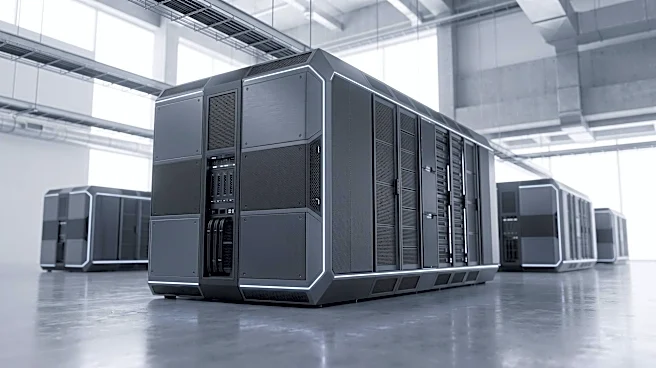
connectivity, and the ability to operate offline. Edge computing typically runs on servers or compute nodes located near operational sites such as factories, campuses, or carrier networks. This distributed processing model is becoming increasingly vital for services that demand low latency and high concurrency, particularly within microservice architectures. The trend is further reinforced by governmental initiatives, such as China's 'AI + Manufacturing' action plan, which advocates for the development of on-device inference chips and edge-computing servers. Edge computing is especially well-suited for tasks that interact directly with the physical world, including perception, on-site prediction, and decision support, where immediate data analysis is crucial.
Why It's Important?
The shift towards edge computing holds substantial importance for U.S. industries, particularly in sectors requiring real-time data processing and autonomous operations. By bringing computation closer to the data source, edge computing significantly reduces latency, which is critical for applications like autonomous vehicles, industrial automation, and smart city infrastructure. This localized processing enhances operational efficiency and safety in environments where split-second decisions are necessary. For instance, in manufacturing, edge computing enables predictive maintenance and quality control, while in healthcare, it facilitates remote diagnostics and wearable health monitoring. The ability to operate offline also ensures business continuity in areas with intermittent network connectivity. Companies that invest in scalable, interoperable, and energy-efficient edge infrastructure stand to gain a competitive advantage by improving application responsiveness and reducing reliance on centralized cloud services, thereby optimizing costs and enhancing data security.
What's Next?
The future of edge computing is expected to involve a multilayered AI infrastructure that extends from the cloud to the edge and down to individual devices. Large AI data centers will continue to handle frontier-model pretraining and complex inference, while edge nodes will provide real-time inference and data processing near operational sites. Devices such as cars and robots will increasingly perform sensing, prediction, and decision support directly. This evolution will drive demand for new types of chips optimized for power, space, cooling, and cost constraints at the edge, rather than solely focusing on maximum computing power. Stakeholders, including technology companies, telecom providers, and various industries, will need to validate how chips, models, software, networks, data, and business processes can work together as complete solutions. The market is also expected to see continued growth in private deployments for organizations with stringent data security and regulatory requirements, further decentralizing AI compute capabilities.
Beyond the Headlines
Beyond its immediate technical and economic implications, the rise of edge computing signals a deeper shift in organizational design and the nature of work. As AI capabilities become more distributed and embedded in operational environments, companies will increasingly manage 'digital employees' that operate alongside human workers. This necessitates a rethinking of the division of labor, data access, permissions, and task autonomy between human and AI entities. The integration of edge AI will influence how information flows, where decisions are made, and how work is structured within enterprises. This transformation extends beyond merely adopting new technology; it requires a new systems mindset to organize compute, data, and both human and digital employees into an integrated, continuously learning, and collaborative system. The long-term impact could redefine corporate value creation by leveraging localized intelligence and real-time responsiveness across diverse business scenarios.