



What's Happening?
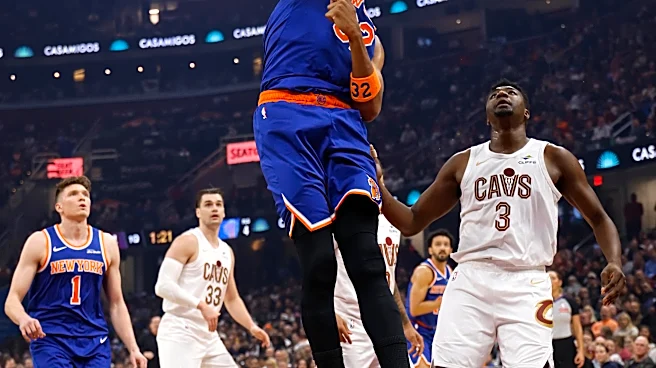
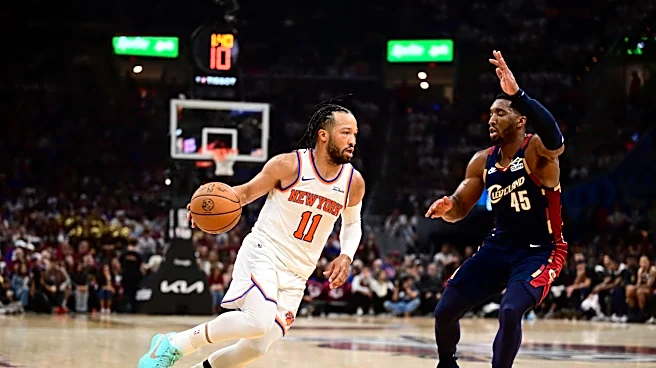
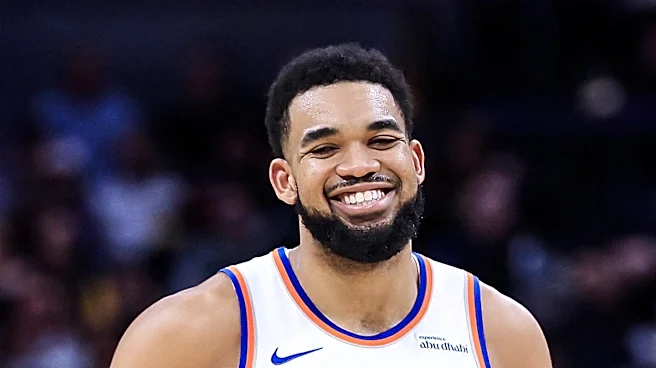
The New York Knicks have reportedly put a potential trade for Karl-Anthony Towns on the table as negotiations for his contract extension have stalled. Towns is eligible for a four-year extension worth approximately $276 million. However, Knicks owner
James Dolan has reportedly issued a mandate to avoid entering the second luxury tax apron, complicating financial discussions. Towns, 30, has two years remaining on his current contract, with the final year being a player option, which could allow him to become an unrestricted free agent in 2027. According to Sean Deveney of Heavy on Sports, the Knicks have made it clear to Towns that a trade is an option if he considers leaving the franchise. Stefan Bondy of The New York Post reported that Towns previously turned down a four-year, $200 million offer, which was $77 million below his maximum and a pay cut from his current $57 million salary.
Why It's Important?
This situation is critical for the New York Knicks' long-term roster construction and financial strategy. Owner James Dolan's mandate to avoid the second luxury tax apron significantly impacts the team's ability to retain key players and acquire new talent. The potential trade of Karl-Anthony Towns, a significant player, could reshape the team's competitive outlook and fan expectations. The financial gap between Towns' eligibility and the Knicks' offer highlights the challenges NBA teams face in managing player salaries under the league's collective bargaining agreement. This decision will affect not only Towns' career but also the future contract negotiations for other Knicks players like Josh Hart and Jalen Brunson, who are also eligible for extensions. The outcome will demonstrate the team's willingness to invest heavily in its current roster versus pursuing alternative strategies to maintain financial flexibility.
What's Next?
Negotiations between the New York Knicks and Karl-Anthony Towns are expected to continue, with the team needing to decide whether to meet his financial demands or explore trade options before his contract situation becomes more complex. The upcoming season will be crucial, as Towns' performance and the team's success could influence the urgency and terms of any potential agreement. If an extension cannot be reached, the Knicks may actively seek trade partners to avoid losing Towns without compensation, especially if he opts out in 2027. The team's financial constraints, particularly the luxury tax apron, will remain a significant factor in all future roster decisions. The situation will likely be a hot topic throughout the season, with a resolution expected before Towns' player option decision in 2027.
Beyond the Headlines
The standoff between the New York Knicks and Karl-Anthony Towns over his contract extension reflects a broader tension in professional sports between player market value and team financial constraints, particularly under the NBA's luxury tax rules. Owner James Dolan's reported mandate to avoid the second luxury tax apron underscores the increasing financial pressures on team owners to balance competitiveness with fiscal responsibility. This situation also highlights the power dynamics in player-team negotiations, where a player's eligibility for a substantial extension can clash with a team's desire for financial flexibility. The outcome could set a precedent for how the Knicks manage future high-value contracts and might influence other teams facing similar luxury tax concerns, potentially leading to more strategic trades or a shift in player acquisition philosophies across the league.