





What's Happening?
Southwest Airlines is detailing the benefits for its A-List and A-List Preferred loyalty tiers for 2026, ahead of a significant rebranding scheduled for January 1, 2027. The current A-List tier requires 20 one-way qualifying flights or 35,000 tier qualifying points
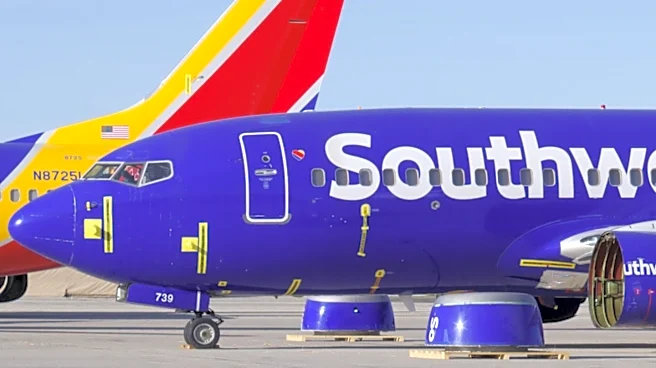
(TQPs) annually, offering a 25% earning bonus on flights, free first checked bag, and Group 1 boarding. The A-List Preferred tier, requiring 40 one-way flights or 70,000 TQPs, provides a 100% earning bonus, two free checked bags, boarding before Group 1, and the ability to select any seat, including Extra Legroom, at booking. A notable change effective January 27, 2026, is Southwest's shift from open seating to assigned seating, categorizing seats into Extra Legroom, Preferred, and Standard. This change impacts how A-List and A-List Preferred members utilize their seat selection perks. The airline's fleet consists entirely of Boeing 737s, with 803 aircraft as of June 2026, comprising 737-700, 737-800, and 737 MAX 8 models. Both tiers allow members to choose seats for up to eight additional people on the same reservation.
Why It's Important?
These adjustments to Southwest Airlines' loyalty program are significant for frequent U.S. travelers, particularly those who rely on the airline for business or personal travel. The shift to assigned seating fundamentally alters the value proposition of early boarding, as seat choice is now guaranteed rather than a scramble. For A-List Preferred members, the ability to secure Extra Legroom seats at booking provides a tangible comfort benefit, while A-List members must wait until 48 hours before departure, risking availability. The substantial difference in earning bonuses—100% for A-List Preferred versus 25% for A-List—means that high-frequency flyers will accumulate points much faster, potentially leading to more free flights or upgrades. The free second checked bag for A-List Preferred members also offers considerable savings for those who frequently travel with multiple bags, amounting to $1,400 annually for a traveler checking two bags on 40 one-way trips. These changes could influence traveler behavior, encouraging some to increase their flight frequency with Southwest to reach the higher tier and maximize benefits, especially before the 2027 rebranding.
What's Next?
On January 1, 2027, Southwest Airlines will rename its A-List tier to Silver and A-List Preferred to Gold, introducing a new Platinum tier above them. Members who achieve A-List Preferred status in 2026 will transition to Gold and retain the 100% earning bonus through December 31, 2027, a benefit that new Gold members in 2027 will not receive. A-List members from 2026 will become Silver. The new program will require 35,000 TQPs or 25 flights for Silver status and 65,000 TQPs or 50 flights for Gold, with Gold's earning bonus set at 60%. This transition period makes 2026 a critical year for frequent flyers to maximize their status under the current rules to secure enhanced benefits for 2027. Travelers will need to evaluate their flight patterns and spending to determine if pushing for A-List Preferred in 2026 is advantageous, particularly given the retention of the 100% bonus for an additional year. The airline's communication indicates that Silver members will continue to pay $35 for a second checked bag through 2027, but details on their earning bonus retention are not yet specified.
Beyond the Headlines
The evolution of Southwest Airlines' loyalty program reflects a broader trend in the U.S. airline industry towards tiered benefits and personalized travel experiences. The shift from open seating to assigned seating, while potentially controversial for some long-time Southwest customers, aligns the airline more closely with industry standards and allows for more granular control over seat inventory and premium offerings. This move could also be seen as an effort to enhance revenue streams through differentiated services, such as Extra Legroom seats. The emphasis on earning bonuses and free checked bags for higher tiers highlights the airline's strategy to foster customer loyalty among its most frequent and valuable passengers. The upcoming rebranding to Silver, Gold, and Platinum tiers, along with adjusted qualification requirements, suggests a strategic repositioning of the loyalty program to compete more effectively with other major U.S. carriers that already utilize similar hierarchical structures. This could lead to increased competition for elite status members and potentially influence pricing strategies and service offerings across the domestic airline market.