




What's Happening?
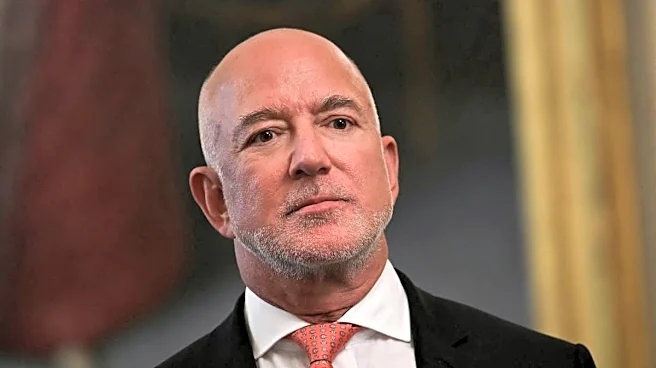
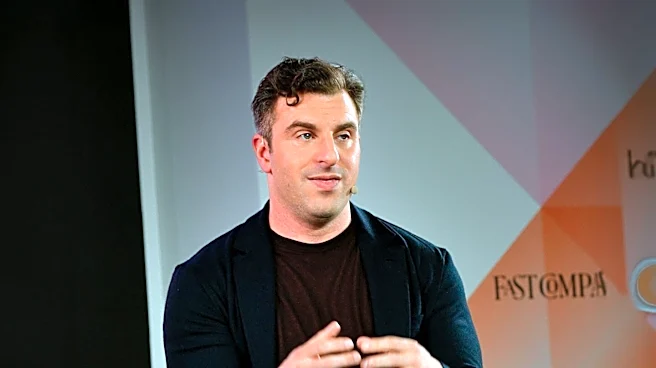
Brian Chesky, co-founder and CEO of Airbnb, has stated that artificial intelligence (AI) is significantly reducing the staffing and resource requirements for new businesses. According to Chesky, AI tools are now so powerful that ambitious products and companies
can be launched by very small teams, sometimes as few as one to three people, a possibility he described as previously 'inconceivable.' He expressed a wish to be 26 again, citing the enhanced capabilities of current AI compared to when he started Airbnb. Chesky's comments, made in a podcast published on October 1, reflect his belief that AI is fundamentally altering the economics of starting a business. He anticipates the emergence of many more large AI companies, alongside tens of millions of smaller businesses, and encourages individuals intimidated by AI to begin experimenting with the technology. Chesky also pointed to potential AI applications in education, health, and entertainment, envisioning an 'AI Disney' as an example of future AI-driven ventures.
Why It's Important?
This perspective from a prominent tech CEO like Brian Chesky underscores a significant shift in the entrepreneurial landscape, particularly within the U.S. business sector. The reduced need for large teams and extensive resources, facilitated by AI, could democratize entrepreneurship, allowing a broader range of individuals and smaller entities to innovate and compete. This could lead to an acceleration of new business formation, fostering economic growth and job creation in novel sectors. However, it also implies potential disruption for traditional business models that rely on larger workforces, possibly leading to shifts in employment patterns and skill demands. The emphasis on AI's power suggests a future where technological proficiency becomes even more critical for business success, potentially widening the gap between those who can leverage AI and those who cannot. Furthermore, the vision of 'AI Disney' hints at transformative changes across various industries, from entertainment to healthcare, driven by AI-powered solutions.
What's Next?
The trend highlighted by Brian Chesky suggests a future where AI integration will become a standard expectation for new businesses. This could lead to increased investment in AI development and education, as entrepreneurs seek to harness these powerful tools. We may see a surge in 'micro-startups' capable of achieving significant impact with minimal human capital. Regulatory bodies might also begin to examine the implications of this shift, particularly concerning market concentration, competition, and labor displacement. Businesses that fail to adapt to AI-driven efficiencies could face increasing competitive pressure. Additionally, the development of AI-driven applications in sectors like education and health could lead to new products and services that redefine these industries, prompting further innovation and potentially new ethical and societal considerations.
Beyond the Headlines
Beyond the immediate economic implications, the ease of starting companies with AI raises deeper questions about the nature of work, creativity, and human-machine collaboration. If small teams can achieve what once required large corporations, it could lead to a re-evaluation of corporate structures and the value of human labor in an AI-augmented world. There's a potential for a more distributed and agile economy, but also concerns about the concentration of AI power and the ethical considerations of AI-driven innovation. The idea of an 'AI Disney' suggests a future where AI not only assists in creation but also becomes a creative force itself, blurring the lines between human and artificial ingenuity. This shift could challenge existing intellectual property laws and societal norms around authorship and originality, prompting a broader societal dialogue on the role of AI in shaping our future.