


What's Happening?
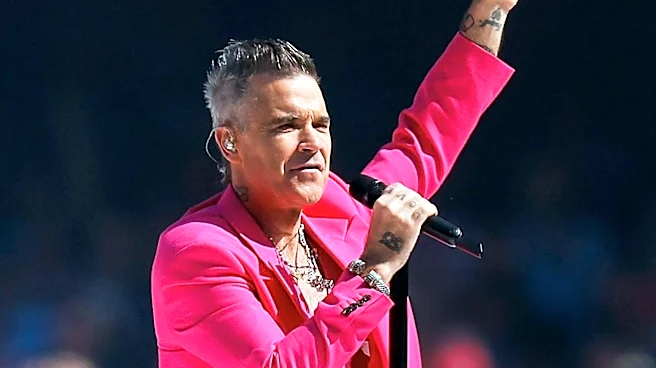
British rock star Robbie Williams has publicly defended Filipino-American singer Olivia Rodrigo following claims that her new holiday song, 'Take Me Home (4 Christmas),' sounds similar to his 2012 track, 'Candy.' Williams addressed the issue on Instagram,
stating he 'couldn't care less' about the similarities and would 'not go after her.' He emphasized that there are a finite number of musical notes and chords, making accidental resemblances inevitable. Williams praised Rodrigo's work, calling himself a fan since her debut album 'Sour,' and expressed admiration for her artistry. He also criticized what he termed 'ambulance chasing' in the music industry, where artists or their representatives pursue legal action over vaguely familiar musical sequences, suggesting it stifles creativity.
Why It's Important?
This event highlights ongoing debates within the music industry regarding copyright, originality, and the creative process. Williams's stance challenges the increasingly litigious environment surrounding musical similarities, which can have significant financial and reputational consequences for artists. His comments about 'ambulance chasing' resonate with concerns that the pursuit of copyright infringement claims, even for minor resemblances, can disproportionately benefit legal teams and rights holders while potentially stifling artistic innovation. For emerging artists like Olivia Rodrigo, such public defenses from established figures can offer crucial support and potentially deter costly legal battles, allowing them to focus on their creative output rather than defending against claims of unintentional similarity.
What's Next?
While Robbie Williams has made it clear he will not pursue action against Olivia Rodrigo, the broader conversation about musical originality and copyright enforcement is likely to continue. This incident may encourage other established artists to voice similar opinions, potentially influencing how future claims of song similarity are perceived and handled within the industry. For Olivia Rodrigo, this public backing could strengthen her position against future 'copycat' accusations, allowing her to maintain her creative freedom without constant fear of legal challenges. The music industry may see continued discussions on developing clearer guidelines or alternative dispute resolution mechanisms for such cases, aiming to balance artist protection with the encouragement of creative expression.
Beyond the Headlines
The incident touches upon the philosophical question of originality in an art form built on a shared language of notes and rhythms. Williams's argument that 'we all stand on the shoulders of people who came before us' underscores the evolutionary nature of music, where influence and unconscious echoes are often part of the creative process. The 'ambulance chasing' critique points to a potential commodification of intellectual property, where legal claims become a business strategy rather than a genuine defense of unique artistic creation. This dynamic can create a chilling effect, leading artists to self-censor or avoid certain melodic or harmonic progressions, thereby limiting the diversity and innovation within music. The ethical implications extend to how the industry values artistic inspiration versus strict adherence to proprietary claims.