





What's Happening?
The U.S. commercial real estate market, particularly its office sector, is experiencing significant distress due to a combination of elevated interest rates and the lasting impact of hybrid and remote work arrangements. According to Trepp data, the delinquency
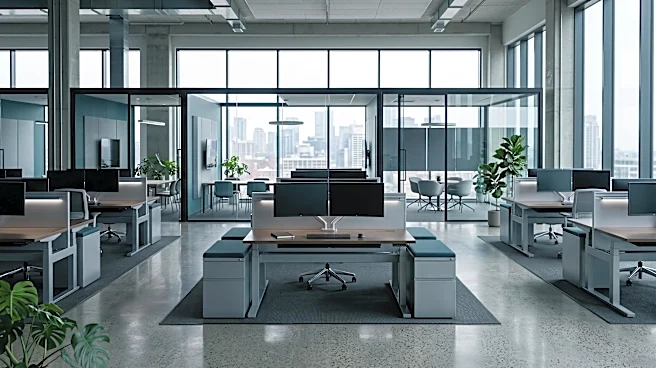
rate on commercial mortgage-backed securities (CMBS) backed by office loans has hovered near a 12% peak for approximately ten months, a five-fold increase from 2.5% in 2021. MSCI estimates that over 20% of offices with loans maturing in the second half of 2026 are underwater, meaning their mortgage exceeds the property's value. The shift to remote work has led to historically high vacancy rates in major metropolitan areas, with no clear recovery trajectory. This structural change in how corporate occupiers use space, coupled with higher borrowing costs, is creating a challenging refinancing environment for maturing debt. Lonnie Hendry, chief product officer at Trepp, notes that the market is nearing 'peak distress,' with some troubled buildings facing valuation declines of up to 40%.
Why It's Important?
This situation is critical for the U.S. economy and financial stability. The commercial real estate sector, especially office properties, is heavily leveraged, and even small shifts in borrowing costs can drastically alter property economics. A wave of defaults is anticipated as borrowers struggle to refinance loans originated during periods of historically low interest rates. Lenders are becoming less willing to extend or modify loans without additional equity, moving away from the 'extend and pretend' strategy. This could lead to increased distressed sales, further depressing property values. The potential for significant losses could impact financial institutions holding these loans, affecting broader credit markets. The ongoing devaluation of office properties also has implications for municipal tax revenues, which often rely on property values, potentially leading to cuts in public services or increased taxes for residents.
What's Next?
The commercial real estate market is bracing for a wave of loan maturities, with approximately $22 billion of office CMBS loans reaching final maturity in 2027, according to Trepp. MSCI estimates that over $310 billion in U.S. commercial real estate loans are set to mature in the second half of this year, with about half originating in 2021 when borrowing costs were minimal. Experts like Rob Koonin, co-head of Polsinelli's New York real estate practice, suggest it could take up to 12 months for the full impact of higher rates to manifest in office valuations, with some Class B buildings potentially seeing a 10% decline. The market will likely continue to see increased distressed sales, as evidenced by a 53% surge in such sales last year, totaling $5.2 billion. Stabilization is expected only after troubled office prices correct, which could then lead to increased deal activity and occupancy in these buildings.
Beyond the Headlines
The current distress in the commercial real estate office sector highlights a fundamental shift in urban planning and corporate culture. The permanent adoption of hybrid and remote work models challenges the traditional role of central business districts and large office complexes. This could lead to a re-evaluation of urban infrastructure, with potential for repurposing office buildings into residential units or mixed-use developments, though such conversions are complex and costly. The situation also exposes vulnerabilities in financial underwriting practices that may not have adequately accounted for structural changes in demand. Furthermore, the crisis could accelerate technological adoption in real estate management and valuation, as stakeholders seek more accurate and dynamic assessments of property values and market trends. The long-term implications extend to how cities are designed, how people commute, and the economic viability of urban centers that have historically relied on a robust office presence.