



What's Happening?
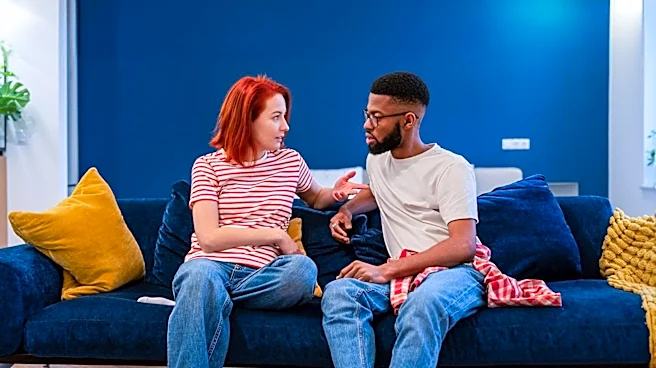
A significant number of Americans, over one-third, have reportedly ended relationships due to political disagreements, and these divisions are increasingly straining marriages. Anna Elton, Ph.D., a licensed marriage and family therapist and clinical sexologist
in Massachusetts, has observed this trend in her practice, noting that many couples struggle to discuss politics without conflict. For younger adults, political compatibility has become a crucial factor in dating, with some making assumptions about potential partners based solely on their political affiliation. This can lead to individuals deciding against dating someone if their political views do not align. Elton highlights that for long-married couples, current political polarization presents challenges that were not present when their relationships began, necessitating new strategies for managing these discussions.
Why It's Important?
The increasing polarization of U.S. politics is not only impacting the national discourse but also deeply affecting personal relationships and family dynamics. The statistic that over one-third of Americans have ended relationships over political differences underscores the profound societal impact of political division. This trend can lead to increased social fragmentation, as individuals may become less willing to engage with those holding differing views, even within their closest circles. For couples, the inability to navigate political discussions constructively can erode intimacy, trust, and shared values, potentially leading to relationship dissolution. This phenomenon also highlights a broader societal challenge where political identity is becoming intertwined with personal identity, making disagreements feel more personal and threatening to relationships. The advice from therapists like Dr. Elton becomes crucial in fostering healthier communication and preserving relationships amidst a highly charged political landscape.
What's Next?
To address the challenges of political differences in relationships, Dr. Elton suggests three key strategies. First, couples should establish boundaries before engaging in political conversations, setting a constructive tone and limiting exposure to excessive political content, especially on social media, which can create echo chambers. Second, she advises couples to 'agree to disagree,' emphasizing that love and respect can coexist with differing political views. This involves approaching disagreements with curiosity rather than taking them personally and focusing on common ground. Third, couples should consider the wider impact of their political discussions, particularly avoiding triangulation by confiding in family or friends against their partner. Instead, she recommends seeking professional help if needed. These strategies aim to help couples maintain connection and understanding, preventing political discord from leading to relationship breakdown.
Beyond the Headlines
The phenomenon of political differences straining and ending relationships points to a deeper societal shift where political affiliation has transcended mere policy preferences to become a core component of personal identity and moral values. This can lead to a 'moralization' of politics, where opposing views are not just different but are perceived as morally wrong, making compromise and empathy difficult. The reliance on social media for political information further exacerbates this by creating echo chambers and reinforcing confirmation bias, making it harder for individuals to understand or even tolerate alternative perspectives. The breakdown of relationships over politics also has broader implications for social cohesion, potentially leading to more segregated communities and a decline in cross-partisan understanding. The challenge extends beyond individual couples to the fabric of society, highlighting the need for greater media literacy, critical thinking, and a renewed emphasis on civil discourse to bridge divides.