








What's Happening?
An advertising campaign for Novig, a sports prediction market, featuring actor Sydney Sweeney in a nearly nude pose amidst athletic gear, has ignited a debate about the representation of women in sports and objectification. The ad's slogan, 'just sports,'
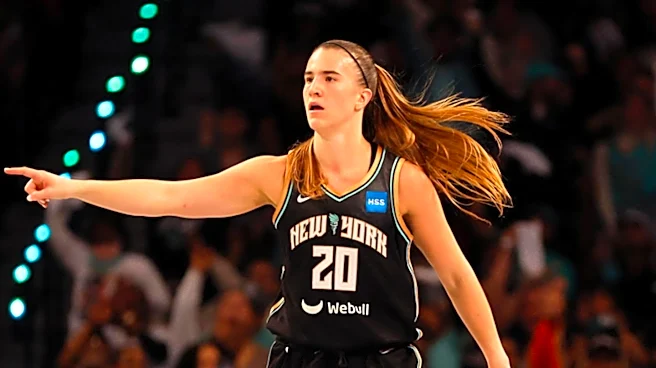
juxtaposed with Sweeney's eroticized image, has drawn criticism from women athletes. British sprinter Amy Hunt, among others, responded by posting images and footage of their bodies actively training and competing, emphasizing the physical realities of athletic achievement. The Wall Street Journal reported that Sweeney is an equity partner in Novig and played a significant role in the campaign's visual direction and messaging. This involvement complicates the critique, as Sweeney is not merely a passive subject but an active commercial participant benefiting from her image.
Why It's Important?
This controversy is important because it highlights a structural issue in commercial culture: the tendency to give greater visibility to women's bodies positioned adjacent to sport rather than to the women whose labor constitutes it. While individual agency allows Sweeney to profit from her image, the campaign's use of the male gaze and its focus on erotic appeal over athletic performance raises concerns about how attention is allocated and monetized. The athletes' response underscores a collective grievance that their hard work, discipline, and physical achievements are often overshadowed by commercialized sexuality. This dynamic creates a hierarchy of recognition where celebrity and conventional beauty standards can garner more attention than genuine athletic prowess, impacting sponsorship opportunities and institutional investment in women's sports.
What's Next?
The debate is likely to continue, with ongoing discussions about the balance between individual agency and collective representation in media. The increased visibility of the Novig campaign, partly fueled by the backlash, demonstrates how criticism can inadvertently amplify an advertisement's reach. This situation may prompt more athletes and advocates to actively challenge commercial imagery that they perceive as undermining the integrity of women's sports. It could also lead to a re-evaluation by brands and advertising agencies of how they portray women, particularly in contexts related to sports, to ensure that their campaigns align with values of empowerment and respect for athletic achievement. The conversation will likely evolve to explore how to create commercial content that celebrates both the athleticism and the diverse forms of beauty in women without resorting to objectification.
Beyond the Headlines
The deeper implications of this controversy touch upon the complex interplay of feminism, commercialism, and the attention economy. It reveals that while individual women can exercise agency in how their bodies are presented and monetized, the broader visual culture can still perpetuate objectification and reinforce existing hierarchies. The debate exposes a tension between two feminist claims: the right to individual autonomy and the demand for collective recognition and dismantling of harmful stereotypes. The market's ability to convert disagreement into circulation means that even critical responses can inadvertently serve commercial interests. This situation prompts a critical examination of who truly owns the narrative and the routes through which images become visible, and who ultimately profits from the ongoing public discourse surrounding them, highlighting that agency does not always equate to emancipation from systemic issues.