









What's Happening?
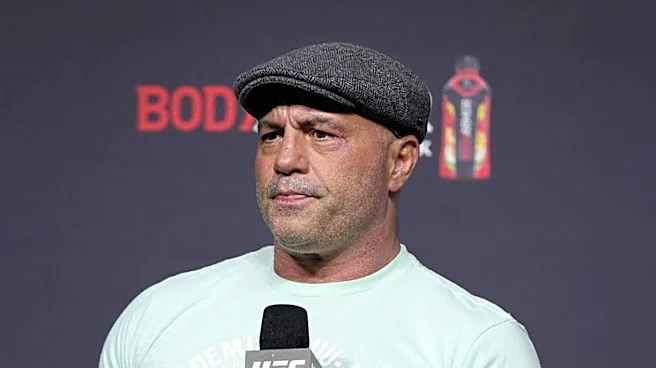
Hollywood producer Chuck Lorre, known for hit sitcoms like 'Two and a Half Men' and 'The Big Bang Theory,' recently appeared on 'The Joe Rogan Experience' podcast to discuss the importance of spirituality. During the interview, Lorre, who has a diverse
religious background including Judaism, Scientology, and Buddhism, emphasized that worldly wealth and fame are ultimately unfulfilling. He asserted that the 'real solution' is a spiritual one, a statement he initially expressed hesitation about making due to concerns about being associated with 'new age bulls---.' Lorre also warned that societies that abandon belief in a supernatural God tend to replace it with extreme ideologies, such as communism or fascism, arguing that these serve as organizing elements in the absence of spiritual frameworks. He compared shared religious beliefs to a 'tent pole' holding society's understanding of reality together, suggesting that challenging these beliefs can lead to anger and uncertainty.
Why It's Important?
Lorre's comments are significant as they come from a prominent figure in the entertainment industry, a sector often perceived as secular or progressive. His assertion that spirituality is the 'real solution' and his warning about societies drifting towards tyranny when abandoning God introduce a profound philosophical and societal debate into mainstream discourse. This perspective challenges the notion that secularism alone can provide sufficient moral or organizational frameworks for society. His comparison of religious beliefs to a 'tent pole' highlights the idea that shared spiritual or moral foundations are crucial for societal cohesion, and their removal can lead to instability and the rise of authoritarian ideologies. This discussion is particularly relevant in the U.S., where debates about the role of religion in public life and the increasing polarization of values are ongoing. Lorre's views could resonate with individuals seeking deeper meaning beyond material success and may spark further conversations about the spiritual health of the nation.
What's Next?
Lorre's remarks on the Joe Rogan podcast are likely to generate further discussion and debate, particularly within media and cultural circles. His perspective, coming from a successful Hollywood producer, might encourage other public figures to openly discuss their views on spirituality and its role in society. The conversation could also prompt a broader examination of the relationship between secularism, spirituality, and political ideologies in the U.S. It may lead to increased dialogue about the potential societal consequences of abandoning traditional belief systems and the search for alternative organizing principles. Furthermore, Lorre's comments could influence how audiences perceive his work, potentially drawing new attention to the underlying themes or values present in his productions. The ongoing public discourse will likely explore whether his warnings about tyranny are alarmist or prescient in the context of contemporary global political trends.
Beyond the Headlines
Beyond the immediate impact, Lorre's statements delve into fundamental questions about human nature, societal structure, and the search for meaning. His argument that societies replace God with extreme ideologies when spiritual frameworks are removed touches upon historical patterns observed in various civilizations. This perspective suggests that humans inherently seek overarching narratives or belief systems to organize their lives and societies, and if traditional spiritual ones are discarded, other, potentially more dangerous, ideologies may fill the void. This raises ethical and philosophical questions about the responsibility of individuals and institutions in fostering a sense of purpose and community. It also highlights the cultural tension between secular humanism and traditional religious or spiritual worldviews. Lorre's insights offer a lens through which to examine the long-term implications of declining religious adherence and the rise of new forms of collective identity and belief in modern American society.