







What's Happening?
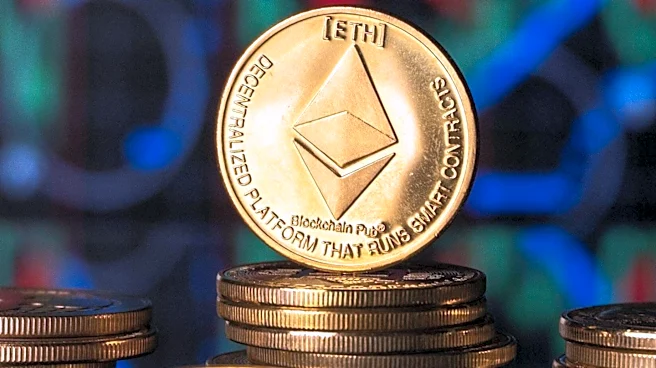
Vitalik Buterin, co-founder of Ethereum, has publicly argued that Ethereum (ETH) should be primarily valued as a store of value, emphasizing its decentralization, security, and resistance to external control, rather than focusing on maximizing transaction-fee
burning. Buterin stated that while EIP-1559 (which includes fee burning) is beneficial and should remain, the long-term investment case for ETH should not hinge on it becoming increasingly scarce through fee destruction. He questioned the strength of the 'ETH as fee-burning token' narrative, suggesting that optimizing for it could compromise affordability and decentralization. Buterin believes ETH can maintain its store-of-value appeal even if fee burning does not consistently offset new token issuance, especially as layer-2 solutions reduce mainnet transaction costs and thus fee burns.
Why It's Important?
Buterin's perspective challenges a significant investment thesis that has underpinned Ethereum's value proposition for many, which posited that continuous fee burning would lead to ETH becoming a deflationary asset, thereby increasing its scarcity and value. By shifting the focus to ETH's role as a secure, censorship-resistant, and stable infrastructure, Buterin is redefining what he sees as the core long-term value driver for the network. This re-emphasis could influence how developers prioritize future upgrades and how investors perceive ETH's fundamental worth. It also highlights a potential tension between maximizing token holder value through scarcity and ensuring the network remains accessible and decentralized, which are crucial for its utility and long-term adoption. The debate reflects the evolving understanding of blockchain economics and value accrual mechanisms.
What's Next?
Buterin's comments are likely to spark further discussion within the Ethereum community and among investors regarding the network's economic model and future development priorities. While EIP-1559 will remain in place, the emphasis on 'store of value' could lead to increased focus on features that enhance security, decentralization, and censorship resistance, such as post-quantum security and privacy tools. Developers may prioritize upgrades that strengthen these aspects, even if they do not directly contribute to higher fee burns. Investors might begin to evaluate ETH less on its deflationary potential and more on its robustness as a foundational layer for decentralized applications and its ability to withstand technological and political pressures. This shift could also influence how other blockchain projects design their tokenomics.
Beyond the Headlines
This discussion delves into the philosophical underpinnings of blockchain value. Buterin's argument suggests that the true long-term value of a decentralized network lies not just in its economic mechanics (like token burns) but in its ability to provide a reliable, neutral, and secure public good. In an increasingly digital and AI-driven world, the demand for stable, censorship-resistant infrastructure could grow significantly, making Ethereum's core properties more valuable than mere scarcity. This perspective also implicitly critiques the 'financialization' of every aspect of blockchain technology, advocating for a return to its foundational principles of decentralization and utility. It raises questions about what truly constitutes value in a digital economy and whether a network's resilience and integrity ultimately outweigh short-term economic incentives for token holders.