




What's Happening?
OYMotion Technologies, a Shanghai-based company specializing in brain-computer interfaces and dexterous robotic hands, has successfully raised several hundred million yuan in a Series D funding round. The investment was jointly led by China Ordnance Shunjing,
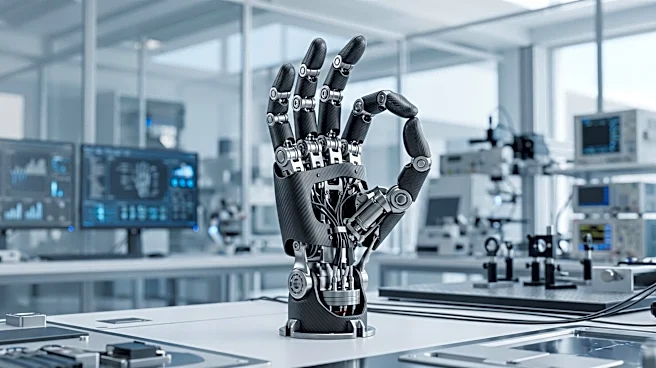
Changjiang Capital, and Optics Valley Industrial Investment, with the announcement made on November 23. This marks OYMotion's second funding round this year, following a US$20.6 million Series C in March, which was led by a brain-science fund under CICC Capital. Founded in 2015, OYMotion develops end-effectors for embodied AI, including multi-finger grippers and dexterous hands across five product series and approximately 20 SKUs. The company also focuses on EMG/EEG sensing, neural rehabilitation exoskeletons, and brain-computer interfaces. OYMotion states that its products are utilized by nearly 200 embodied AI firms and distributed in over 100 countries, supported by a self-built factory in Zhuhai capable of producing tens of thousands of units annually.
Why It's Important?
This significant investment in OYMotion Technologies underscores the growing global interest and capital flow into the embodied AI sector, particularly in components like sensors and end-effectors with tangible real-world applications. For the U.S. market, advancements in dexterous robotic hands and brain-computer interfaces, even from international companies, can have a ripple effect. U.S. companies involved in robotics, automation, and healthcare technology may find new partners, competitors, or suppliers. The deepening of OYMotion's position in the embodied AI supply chain could lead to more sophisticated and accessible robotic solutions globally, potentially influencing U.S. manufacturing, logistics, and medical device industries. The involvement of state-backed industrial capital in China also highlights a strategic national focus on AI development, which could intensify competition and innovation in the global AI landscape, impacting U.S. technological leadership and investment strategies in the long term.
What's Next?
The newly secured funds are intended to further strengthen OYMotion's presence in the embodied AI supply chain. The company's continued expansion and product development are expected to introduce more advanced robotic hands and brain-computer interface technologies to the market. While the specific details of the round size were not disclosed, the influx of capital suggests an accelerated pace of innovation and production. The increasing competition within the dexterous-hand sector, with rival firms also attracting substantial investments, indicates a dynamic and rapidly evolving market. Future developments will likely include OYMotion's efforts to scale its operations, potentially through increased factory output and broader international distribution. The company's founder, Zhang Qi, emphasized continuous evolution, suggesting ongoing product enhancements and strategic adaptations to market changes. The focus on companies with clear real-world use cases for embodied AI components will likely drive further investment and development in this specialized area.
Beyond the Headlines
The investment in OYMotion Technologies reflects a broader trend of capital concentrating on embodied AI companies that offer practical, tangible solutions. This shift highlights a maturation in the AI investment landscape, moving beyond purely software-based AI to hardware components that enable AI to interact with the physical world. The ethical implications of advanced brain-computer interfaces and highly dexterous robotic hands are significant, particularly concerning human-machine interaction, job displacement, and potential dual-use applications. As these technologies become more sophisticated, discussions around regulatory frameworks, data privacy for brain-computer interfaces, and the responsible deployment of embodied AI will become increasingly critical. The involvement of state-owned industrial capital in OYMotion also points to the strategic national importance placed on AI and robotics by certain governments, potentially leading to geopolitical considerations regarding technological leadership and supply chain control in critical AI components.