






What's Happening?
Bartłomiej Kubkowski, a Polish athlete, has revealed that he has not yet regained the joy of swimming following his record-breaking crossing of the Baltic Sea. According to Interia Sport, in an interview with 'Zwierciadło' magazine, Kubkowski stated that he is not ready
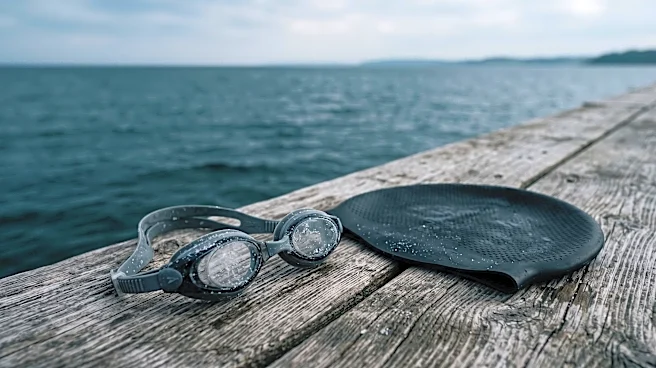
to simply enter the water for leisure. He recently completed his first calm 20-minute training session since the expedition, swimming one kilometer and feeling well, but perceiving the activity as a mechanical execution of movements. Kubkowski explained that for the past six years, every time he entered the water was hard work dedicated to preparing for his goal. He hopes to gradually return to swimming for pleasure now that the project is complete. His record swim across the Baltic Sea, achieved in early August, involved covering 160 kilometers in a straight line over 55 hours without a break, reaching the beach in Pobierowo. Interia Sport recognized this as a new record for the longest unsupported swim.
Why It's Important?
Kubkowski's experience sheds light on the profound psychological and emotional toll that extreme athletic endeavors can take on individuals. For U.S. athletes and sports enthusiasts, this story offers a valuable perspective on the mental health aspects of high-performance sports, highlighting that achieving monumental goals does not always immediately translate into personal fulfillment or renewed passion. It underscores the importance of post-achievement psychological recovery and the need for athletes to reconnect with the intrinsic joy of their sport. This narrative can influence discussions around athlete well-being, training methodologies, and the support systems in place for those who push the boundaries of human endurance, both within the U.S. and internationally. It also serves as a reminder that even record-breakers face personal challenges in their journey.
What's Next?
Kubkowski's immediate future will likely involve a period of physical and psychological recovery, as he aims to rediscover his personal connection with swimming. His journey to regain the joy of the sport will be a personal one, potentially involving different approaches to training and water activities. This period of adjustment could also lead to him sharing his experiences more widely, contributing to broader conversations about athlete mental health and the transition phases after major athletic achievements. His story may inspire other athletes to prioritize their emotional well-being alongside their physical training, fostering a more holistic approach to sports performance and life after competition.
Beyond the Headlines
This story delves into the deeper psychological implications of pursuing and achieving extreme goals. It raises questions about the nature of passion, the potential for burnout, and the process of finding meaning in activities once they become intensely goal-oriented. Kubkowski's struggle to find joy in swimming after his record-breaking feat illustrates how the pursuit of external validation or a singular objective can sometimes overshadow the inherent pleasure of an activity. This phenomenon is not unique to sports but can be observed in various high-pressure fields. His experience offers a poignant reflection on the human need for balance, the importance of intrinsic motivation, and the challenge of transitioning from a state of intense focus to one of relaxed enjoyment, providing a valuable lesson for anyone engaged in demanding pursuits.