





What's Happening?
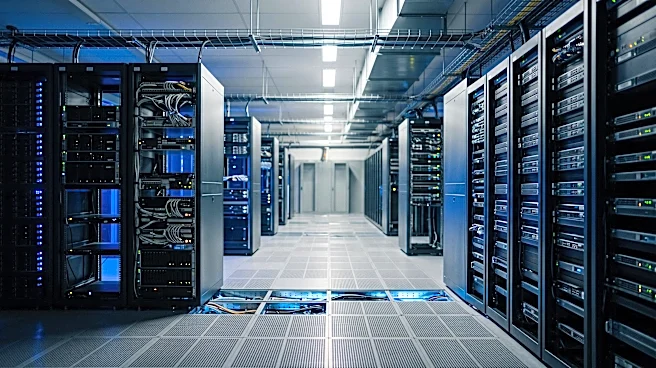
SoftBank Group disclosed a ¥597.2 billion (approximately $3.7 billion) loss related to revised procurement plans for US artificial intelligence data center power infrastructure. This charge, detailed in its November 10 earnings presentation, stems from
advance equipment commitments made by its subsidiary, Silver Bands 7 LLC (SB7), which is backed by SoftBank Group and SoftBank Vision Fund 2. SB7 had entered into manufacturing-capacity reservation agreements and equipment purchase contracts to support US AI data center power infrastructure, with cumulative payments reaching ¥1,500.886 billion ($9.48 billion) through September 30, 2026. The procurement plans were subsequently altered due to evolving requirements of existing and planned projects, leading to non-refundable advance payments and contract modification costs. This loss was part of a larger ¥768.0 billion net loss for April–September, with July–September alone producing a ¥1,115.3 billion loss ($7.0 billion).
Why It's Important?
This significant loss highlights the financial risks and exposure associated with large-scale infrastructure investments in the rapidly evolving AI sector, particularly in the United States. For companies like SoftBank, which are heavily invested in AI, the need to secure physical power infrastructure ahead of anticipated supply constraints can lead to substantial financial penalties if project requirements change. This event underscores the volatility and unpredictability in the AI infrastructure market, where rapid technological advancements and shifting project scopes can quickly render prior commitments obsolete. It also provides a concrete example for research institutions and businesses of the financial implications when procurement plans for critical infrastructure, such as AI data centers, are modified after initial payments have been made. The incident could prompt a re-evaluation of risk management strategies for future AI infrastructure investments across the industry.
What's Next?
SoftBank anticipates recouping $5.6 billion from the PORTS-Pike power-generation project, with $3.4 billion expected in the near term and $2.2 billion by the end of 2027. An additional $1.0 billion is expected to be recouped over time from other projects. The company also has rights to conditional rebates of up to $2.1 billion on future qualifying equipment purchases, though the timing and amounts are undetermined, and no asset has been recognized for these. Management has indicated that further procurement changes could lead to additional losses. This situation will likely lead to increased scrutiny of SoftBank's future AI infrastructure investments and its ability to manage large-scale, complex procurement contracts. The broader AI industry may also observe these developments closely, potentially influencing how other major players approach their own infrastructure build-outs and risk assessments.
Beyond the Headlines
The incident reflects a broader challenge within the AI industry: the immense capital expenditure required for advanced computing infrastructure and the inherent uncertainties in long-term planning for rapidly evolving technology. The need to secure manufacturing capacity and equipment far in advance, coupled with the dynamic nature of AI development, creates a high-stakes environment where even minor shifts in project scope can result in substantial financial write-downs. This could lead to a more cautious approach to large-scale, speculative infrastructure investments in the AI sector, potentially favoring more flexible or modular solutions. It also raises questions about the balance between aggressive expansion to capture market share and prudent financial management in a nascent but capital-intensive industry.