






What's Happening?
For the week of November 8, 2026, 'The Tonight Show Starring Jimmy Fallon' averaged 1.335 million total viewers, marking a 2 percent decrease from the previous week, according to Nielsen Live+3 ratings. However, the show experienced an 18 percent increase
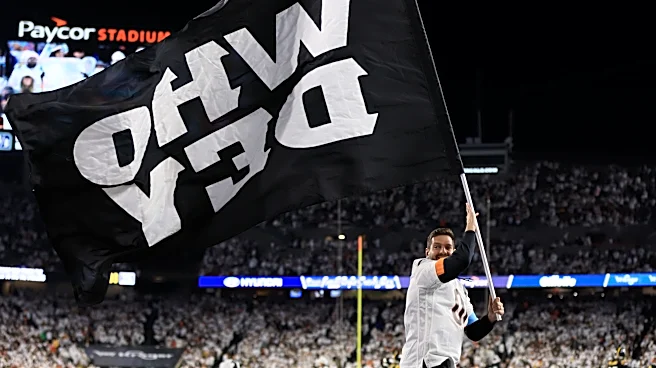
in the adults 18–49 demographic, reaching 209,000 viewers. This demographic gain was largely attributed to a special Sunday night episode that aired at 12:42 a.m. following an NBC Sunday Night Football game. This post-football broadcast, featuring the cast of 'Focker-in-Law,' attracted 376,000 adults 18–49, which was more than double the demographic audience of any of the show's regular Monday-through-Friday episodes. Excluding this Sunday broadcast, 'The Tonight Show' averaged approximately 176,000 adults 18–49 for the rest of the week, remaining largely consistent with the prior week's average of 177,000. During this period, Jimmy Fallon aired four original episodes and two repeats, with Thursday and Friday featuring reruns.
Why It's Important?
The ratings data for 'The Tonight Show Starring Jimmy Fallon' highlights the significant impact of strategic scheduling, particularly the leverage gained from a strong lead-in like NFL football. While overall viewership saw a slight decline, the substantial boost in the key 18–49 demographic from the Sunday late-night slot demonstrates the potential for targeted programming to capture younger audiences. This indicates that traditional linear television still holds considerable power when paired with major live events. For advertisers, the ability to reach a larger younger demographic, even if intermittently, is valuable. The consistent performance of the show during its regular weekday slots, when excluding the football-boosted episode, suggests a stable core audience, but also points to the challenges of growing that audience without external factors. This trend underscores the evolving landscape of television viewership, where special events and strategic scheduling are crucial for maintaining and growing audience engagement in a fragmented media environment.
What's Next?
The success of 'The Tonight Show' in leveraging a post-football slot may encourage NBC and other networks to further experiment with similar scheduling strategies for late-night programming. This could lead to more special weekend editions or late-night shows being paired with major sporting events or other high-profile broadcasts to capture spillover audiences. Networks might analyze these ratings to identify optimal lead-in opportunities, potentially shifting resources or promotional efforts to capitalize on these moments. Additionally, the data reinforces the ongoing importance of the 18–49 demographic for advertisers, suggesting that shows will continue to seek ways to attract and retain this group, even if it means unconventional scheduling. Future programming decisions for 'The Tonight Show' and its competitors may increasingly consider how to integrate with broader network programming schedules to maximize viewership and demographic reach.
Beyond the Headlines
The Nielsen Live+3 ratings for 'The Tonight Show' offer a glimpse into the broader shifts in television consumption and the strategies networks employ to adapt. The reliance on a football lead-in for a significant demographic boost underscores the declining power of traditional weeknight programming to independently draw large, young audiences. This trend suggests a future where late-night television might become more event-driven or integrated into larger network programming blocks, rather than operating as standalone entities. It also highlights the ongoing challenge for linear television to compete with on-demand streaming services, where viewers have complete control over their viewing schedules. The data implicitly points to the need for networks to innovate beyond traditional broadcast models, potentially by creating more synergistic content across platforms or by investing in unique, high-impact events that can still draw live viewership. The long-term viability of traditional late-night formats may depend on their ability to evolve and integrate with broader media consumption habits.