


What's Happening?
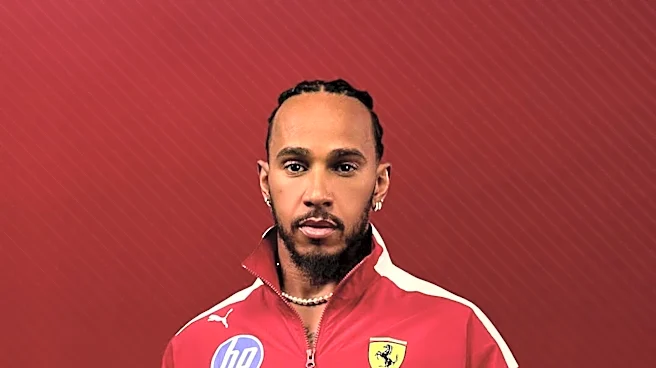
Lewis Hamilton, the renowned racing driver, has acquired a Ferrari F40, a car he describes as his 'dream car.' This acquisition comes approximately a year after Hamilton announced he had sold his entire car collection, valued at around $18 million. He
revealed on Instagram that he found the F40 covered in dust, having been abandoned for over thirty years, and felt compelled to bring it home. The vehicle is now undergoing a restoration project with the assistance of Ferrari's Classiche program, involving master engineers and mechanics at the Maranello factory. Hamilton expressed his long-standing desire for an F40, noting its significance to him, even bringing one with him on his first day at Ferrari last year. The F40 is celebrated as one of Ferrari's most iconic models, with its value significantly increasing in recent years; well-maintained models can fetch upwards of $2.7 million, and a 1991 model recently sold for a record $8.365 million.
Why It's Important?
This event highlights a significant personal investment by a high-profile individual in a classic automotive asset, potentially influencing the collector car market. The involvement of Ferrari's Classiche program in the restoration of Hamilton's F40 underscores the value placed on preserving automotive heritage and authenticity, which can further elevate the desirability and market value of vintage Ferrari models. For the automotive industry, particularly the luxury and classic car segments, such high-profile endorsements and restoration projects can stimulate interest and investment. It also reflects a broader trend among collectors who, despite divesting from modern vehicles, retain a strong appreciation for classic cars that offer a unique emotional and historical connection. The soaring market value of F40s, as evidenced by recent record sales, indicates a robust demand for these rare vehicles, positioning them as significant investment pieces.
What's Next?
Hamilton plans to share more details about the restoration process of his Ferrari F40, inviting followers to 'stay tuned' for updates. This suggests a continued public narrative around the project, which could further engage automotive enthusiasts and collectors. The successful restoration of such a high-profile vehicle by Ferrari's Classiche program will likely serve as a testament to their expertise and could attract more owners of classic Ferraris to utilize their services. The ongoing public interest in Hamilton's F40 could also contribute to the sustained appreciation of the model's market value. Additionally, Hamilton's decision to sell his modern car collection while investing in a classic car like the F40 might signal a shift in collector preferences towards vehicles with historical significance and emotional appeal over contemporary models.
Beyond the Headlines
Hamilton's acquisition and restoration of the Ferrari F40 transcend a simple car purchase; it represents a deep connection to automotive artistry and history. His statement about modern cars 'all looking the same' and lacking 'emotion' points to a broader cultural sentiment regarding mass-produced goods versus handcrafted, iconic designs. This preference for classic vehicles, particularly those with a rich legacy like the F40, highlights a desire for authenticity and a tangible link to a bygone era of engineering and design. The project also underscores the ethical considerations of preserving historical artifacts, as the F40, once 'covered in dust' for decades, is now being meticulously brought back to life. This act of preservation, supported by Ferrari itself, reinforces the idea that certain machines are not merely transportation but works of art deserving of careful stewardship, reflecting a growing appreciation for heritage in a rapidly modernizing world.