






What's Happening?
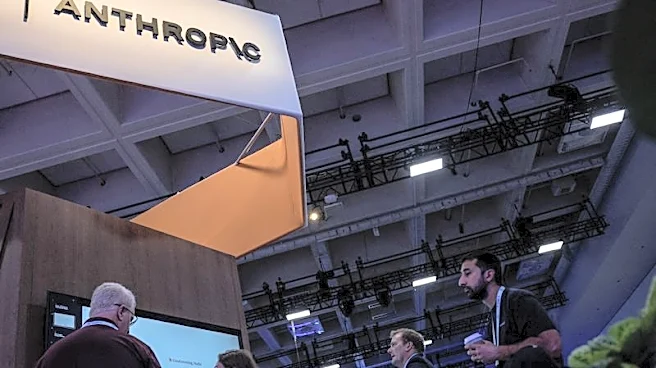
Anthropic, an artificial intelligence company, has announced the opening of its fifth Asia-Pacific office in Singapore and has signed a Memorandum of Understanding (MOU) with Singapore's Ministry of Digital Development and Information. This agreement
outlines a collaboration focused on advancing AI safety, security, and model assessment, studying AI adoption and its effects, and supporting responsible AI integration across both public and private sectors. The MOU also includes initiatives to enhance AI skills among small and midsize businesses and public officers. Anthropic plans to share its research, including findings from its Anthropic Economic Index, and provide technical and policy expertise to aid Singapore's AI regulatory efforts. The company will also exchange technical information with Singapore’s AI safety and assurance institutions on model assessment, testing standards, and incident response. This partnership was formalized during Singapore International Cyber Week, with Singapore Minister for Digital Development and Information Josephine Teo and Anthropic Head of Asia-Pacific Policy Michael Sellitto witnessing the signing.
Why It's Important?
This collaboration signifies a growing trend of AI developers partnering with national governments to shape the future of artificial intelligence responsibly. For Singapore, this partnership with Anthropic, a leading AI firm, is crucial for solidifying its position as a hub for AI innovation and governance in the Asia-Pacific region. By working directly with Anthropic, Singapore gains access to cutting-edge research and technical expertise, which can inform its regulatory frameworks and ensure the safe and ethical deployment of AI technologies. This proactive approach to AI governance can set a precedent for other nations grappling with the rapid advancements in AI. For Anthropic, establishing a physical presence and formal partnership in Singapore provides a strategic foothold in a key Asian market, allowing it to better understand regional needs and contribute to global AI standards. The focus on AI skills development also addresses a critical need for a skilled workforce capable of leveraging AI effectively, benefiting both Singapore's economy and Anthropic's market penetration.
What's Next?
Following the signing of the MOU, Anthropic's new Singapore office will serve as a central point for engaging with local government agencies and businesses that utilize its Claude AI models. The company will proceed with sharing its research and data, including insights from its Economic Index, to support Singapore's AI regulatory development. Technical exchanges on model assessment, testing standards, and incident response will commence with Singapore's AI safety and assurance institutions. Furthermore, initiatives to strengthen AI skills among public officers and small and midsize businesses are expected to be rolled out. This partnership may also lead to further integration of Anthropic's AI models, such as Claude Code, within Singaporean government agencies like GovTech Singapore and the Cyber Security Agency, which are already exploring its applications. The collaboration could also influence broader regional discussions on AI governance and safety, potentially leading to similar partnerships between Anthropic and other Indo-Pacific nations, as seen with its previous MOU with the Australian government.
Beyond the Headlines
This partnership extends beyond immediate technological and economic benefits, touching upon deeper implications for global AI governance and ethical development. By actively collaborating with a national government on AI safety and regulation, Anthropic is contributing to a model where AI companies are not just developers but also key stakeholders in shaping policy. This could foster a more collaborative and less adversarial relationship between the private sector and regulators in the AI space. The emphasis on multilingual red-teaming, with AI models evaluated in English, Mandarin, Malay, and Tamil, highlights a crucial aspect of equitable AI development—ensuring that AI systems are robust and fair across diverse linguistic and cultural contexts. This approach is vital for preventing biases and ensuring AI benefits a broader global population. Furthermore, Singapore's role as a testbed for responsible AI adoption, supported by a major AI developer, could influence international norms and best practices, potentially leading to a more harmonized global approach to AI ethics and safety.