





What's Happening?
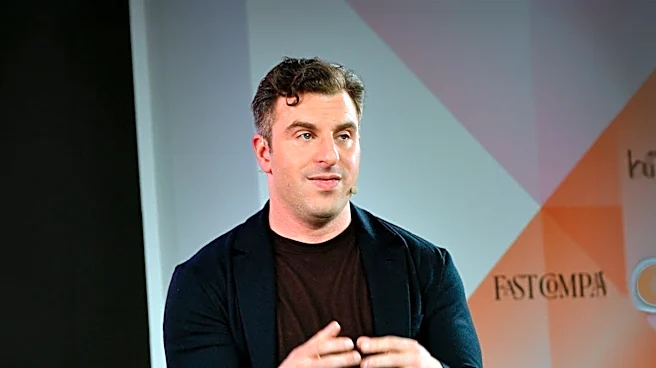
Airbnb CEO Brian Chesky has acknowledged a growing public backlash against Artificial Intelligence (AI), attributing it to the industry's failure to deliver products that genuinely benefit 'regular people.' Chesky, speaking on a recent podcast, suggested
that while there might be a narrative issue in how AI is discussed, the core problem lies in the lack of accessible and appreciated AI applications for everyday users. He emphasized the need for AI to develop more practical tools, citing the example of 'doctor on demand' services that could make healthcare more affordable and accessible. This sentiment aligns with broader trends indicating increasing public unease about AI, with a Pew Research study showing 52% of Americans are more concerned than excited about AI's increased use, up from 37% in 2021. A CNBC poll also revealed that a majority of 18- to 34-year-olds do not trust top AI industry leaders to act responsibly.
Why It's Important?
The growing public skepticism and 'AI backlash' highlighted by Brian Chesky pose a significant challenge to the U.S. technology industry. If consumers do not perceive tangible benefits from AI, or if they view it as a threat to jobs and intellectual property, it could hinder adoption rates and lead to increased regulatory scrutiny. This shift in public sentiment from excitement to concern, as evidenced by various polls, suggests that the industry's current approach to AI development and deployment may be misaligned with societal needs and expectations. Companies that fail to address these concerns by developing user-centric, beneficial AI products risk not only public relations crises but also potential business problems, including reduced market acceptance and increased resistance to new AI initiatives. The emphasis on practical, accessible applications could redefine success in the AI sector, favoring solutions that solve real-world problems for a broad audience over purely technological advancements.
What's Next?
In response to the growing public skepticism, the AI industry is likely to face increasing pressure to pivot towards developing more 'regular' and accessible products that demonstrate clear benefits to everyday users. This could lead to a greater focus on applications that address societal needs, such as healthcare accessibility or educational tools, rather than solely focusing on advanced, complex AI models. Companies may also need to improve their communication strategies to better articulate the value and positive impact of AI, moving beyond technical jargon to highlight practical advantages. Furthermore, the acknowledged 'crisis of trust' within the industry, as noted by Anthropic CEO Dario Amodei, suggests that regaining public confidence will require not just product innovation but also greater transparency and accountability from AI developers and companies. This could manifest in more ethical AI development guidelines and a stronger commitment to addressing potential negative consequences.
Beyond the Headlines
The 'AI backlash' points to a deeper societal reckoning with the rapid advancement of artificial intelligence. Beyond immediate product development and public relations, this sentiment reflects concerns about the ethical implications of AI, including job displacement, data privacy, and the potential for misuse. The comparison to past transformative technologies like the iPhone or the internet suggests that AI's integration into daily life is encountering unique resistance, possibly due to its perceived abstractness and the lack of immediate, universally understood benefits for the average person. This could lead to a cultural shift where consumers increasingly value 'retro technology' or 'grandma hobbies' that offer tangible, human-centric experiences, pushing back against pervasive digital integration. The challenge for the AI industry is not just technological, but also philosophical: how to integrate advanced technology in a way that enhances human well-being and trust, rather than eroding it.