







What's Happening?
Mary E. Lovely, an Anthony M. Solomon Senior Fellow at the Peterson Institute for International Economics (PIIE), is delving into the complexities of global supply chains and the impact of US tariffs. Her research, discussed in a PIIE Insider LIVE session
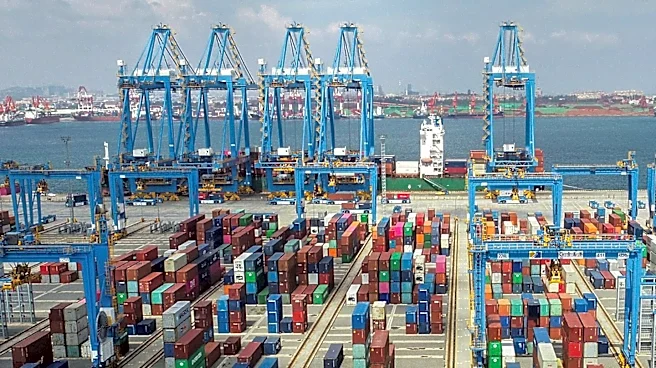
with Anjali V. Bhatt, Communications Manager and Research Fellow at PIIE, addresses critical questions regarding the reorganization of global trade. Specifically, Lovely's work investigates how US tariffs have influenced global supply chains, whether trading patterns between countries are genuinely changing, and what insights can be gleaned from the detailed provisions of trade agreements. The discussion also touches upon the extent to which the US and China are decoupling their economies, providing a comprehensive look at current international trade dynamics.
Why It's Important?
The analysis of global supply chain shifts and US tariffs by the Peterson Institute for International Economics is crucial for understanding the evolving landscape of international trade and its implications for the U.S. economy. Changes in global supply chains directly affect American businesses, from manufacturing to retail, influencing production costs, product availability, and consumer prices. The effectiveness and consequences of US tariffs, particularly in the context of trade relations with major partners like China, have significant ramifications for various U.S. industries. Understanding whether these tariffs are leading to a fundamental reorganization or decoupling of economies helps policymakers, businesses, and economic stakeholders anticipate future challenges and opportunities, impacting investment decisions, job markets, and overall economic stability.
What's Next?
The ongoing research and discussions from the Peterson Institute for International Economics, particularly those led by experts like Mary E. Lovely, will continue to inform policy debates and business strategies concerning global trade. Future analyses are likely to further explore the long-term effects of current trade policies, including the potential for new trade agreements or adjustments to existing tariffs. Stakeholders, including U.S. government officials, industry leaders, and international organizations, will closely monitor these findings to adapt to changing global trade dynamics. The insights gained from this research could influence future U.S. trade policy decisions, potentially leading to revised approaches to international economic engagement and supply chain resilience.
Beyond the Headlines
Beyond the immediate economic implications, the PIIE's research into global supply chains and tariffs touches upon deeper geopolitical and strategic considerations. The concept of 'decoupling' between the US and China, for instance, extends beyond mere trade figures to encompass technological independence, national security, and the broader competition for global influence. The reorganization of supply chains could lead to a more fragmented global economy, potentially increasing regional trade blocs and altering international power dynamics. Furthermore, the ethical dimensions of trade, such as the impact of tariffs on developing economies or the role of trade agreements in promoting labor standards, are often intertwined with these economic shifts, highlighting the complex interplay between commerce, ethics, and international relations.