







What's Happening?
The European Central Bank (ECB) released its latest study on payment attitudes in the euro area (SPACE) on November 25, 2026, indicating a significant shift in consumer payment habits. For the first time since comparable data collection began in 2016,
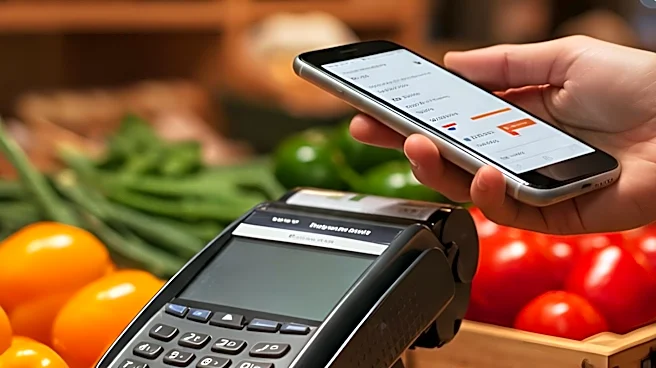
physical cards have surpassed cash as the most frequent payment method in shops. The study found that card payments accounted for 45% of transactions, while cash accounted for 44%. Mobile payments also saw an increase, rising to 9% from 6% in 2024. Despite this trend towards digital payments, the study highlights that consumers highly value the ability to choose between various payment methods. A large majority, 82%, consider the option to pay digitally important, and 62% value the option of paying with cash. Only 3% of respondents reported never using cash. The survey, which covered 51,551 respondents across the euro area, was conducted in two rounds between September 2025 and May 2026.
Why It's Important?
This shift in payment preferences within the euro area reflects broader global trends towards digitalization in financial transactions. While the study focuses on European consumers, the findings offer insights into evolving consumer behavior that could influence payment strategies and technological adoption in other major economies, including the U.S. The continued importance of cash, even as digital payments grow, underscores the need for a diverse payment ecosystem that caters to varying consumer preferences and accessibility needs. For businesses, this means adapting to offer a range of payment options to avoid alienating segments of their customer base. For financial institutions and policymakers, the data reinforces the challenge of balancing innovation in digital currencies, such as the potential digital euro, with the continued safeguarding of traditional payment methods like cash. The study's emphasis on consumer choice suggests that any future payment system must be inclusive and flexible.
What's Next?
The ECB's findings will likely inform its ongoing efforts to ensure payment choice for euro area citizens, including its work on a potential digital euro. Piero Cipollone, a member of the ECB’s Executive Board, stated that the ECB will continue to safeguard cash while preparing for the possible issuance of its digital equivalent. This indicates a dual approach where both traditional and modern payment systems are supported. Businesses in the euro area will likely continue to invest in infrastructure that supports diverse payment methods, including contactless card payments and mobile payment solutions. Furthermore, the slight decline in ease of cash access and reported difficulties with ATM withdrawals, along with instances of non-acceptance of mobile or card payments, suggest that improvements in payment infrastructure and accessibility for all methods will be a focus for both public and private sectors. Future studies will likely track the adoption rates of digital payments and the ongoing relevance of cash.
Beyond the Headlines
The study's results highlight a nuanced evolution in consumer financial behavior, moving beyond a simple dichotomy of 'cash versus digital.' The strong preference for choice suggests a deeper societal value placed on flexibility and autonomy in personal finance. This has implications for financial inclusion, as reliance on a single payment method could disadvantage certain demographics, such as the elderly or those without consistent access to digital technologies. The reported difficulties in accessing cash or experiencing non-acceptance of digital payments point to persistent infrastructure gaps that need addressing to ensure equitable access to financial services. As central banks globally, including those in the U.S., explore central bank digital currencies (CBDCs), the ECB's findings underscore the importance of designing systems that complement existing payment methods rather than entirely replacing them, ensuring a resilient and inclusive financial landscape.