



What's Happening?
U.S. Representative Lateefah Simon, representing California's 12th District, has actively championed the $640 million Turning Basin Widening Project at the Port of Oakland. This initiative aims to modernize the port's estuary to accommodate larger container
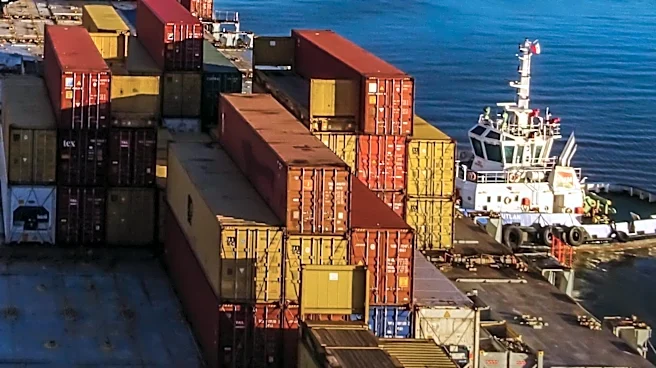
ships, which currently face significant maneuvering challenges due to the narrow turning basins. The project involves widening the estuary between Oakland and Alameda and expanding both the Inner and Outer Harbor turning basins. The U.S. Army Corps of Engineers and Port of Oakland officials recently signed a design agreement, moving the project from the study phase into preconstruction engineering and design. Construction is slated to begin in 2028, with a target completion date of 2030. Representative Simon has requested federal Fiscal Year 2027 appropriations to fund the initial construction contracts and engineering work, emphasizing the project's importance for regional economic value and job sustainability. The Port of Oakland currently supports over $90 billion annually in regional economic activity and serves as a crucial West Coast export hub for U.S. agricultural and manufactured goods.
Why It's Important?
This project is critical for maintaining the Port of Oakland's competitiveness against other major West Coast ports like Los Angeles, Long Beach, and Seattle. Modern container ships, some as long as 1,200 feet, are increasingly common, and the port's current infrastructure, designed in 1999, is inadequate, limiting safe vessel rotation to as few as once a day. The widening will allow for more frequent and safer maneuvers, reducing delays and improving efficiency. Beyond economic benefits, the project is also framed as a long-term investment in job protection for warehouse workers, mechanics, merchant mariners, and truck drivers in the East Bay. Furthermore, the Port of Oakland is integrating environmental commitments, such as joining the Protecting Blue Whales and Blue Skies program, which encourages ships to reduce speed to protect marine life and cut emissions. The project also includes beneficial reuse of dredged sediment for tidal wetland restoration, highlighting a commitment to environmental stewardship alongside economic development.
What's Next?
The immediate next step for the Turning Basin Widening Project is the securing of federal Fiscal Year 2027 appropriations, as requested by U.S. Representative Lateefah Simon. This funding is crucial to launch the first Oakland-side construction contract and complete engineering work on the Alameda side. Following this, construction is scheduled to commence in 2028, with the project expected to be the largest Army Corps effort in the Bay Area during its construction phase. The project is anticipated to be completed by 2030. Continued collaboration among local, state, and federal governments, along with various stakeholders including labor unions, terminal operators, and environmental advocates, will be essential to ensure the project stays on schedule and within budget. The Port of Oakland will also continue its efforts to transition to zero-emissions operations, aligning with its goal of becoming a green innovation hub.
Beyond the Headlines
The Port of Oakland's Turning Basin Widening Project represents a broader trend in global trade infrastructure: the continuous need to adapt to ever-increasing vessel sizes. This constant evolution poses significant challenges for older ports, requiring substantial investment and long-term planning. The project also highlights the complex interplay between economic development, environmental protection, and community benefits. The commitment to using dredged material for wetland restoration and the port's participation in environmental programs demonstrate a growing recognition of the need for sustainable port operations. Furthermore, the project underscores the critical role of federal funding and congressional advocacy in supporting regional infrastructure projects that have national economic implications, particularly for a primary West Coast export hub. The success of this project could serve as a model for other U.S. ports facing similar modernization challenges.