






What's Happening?
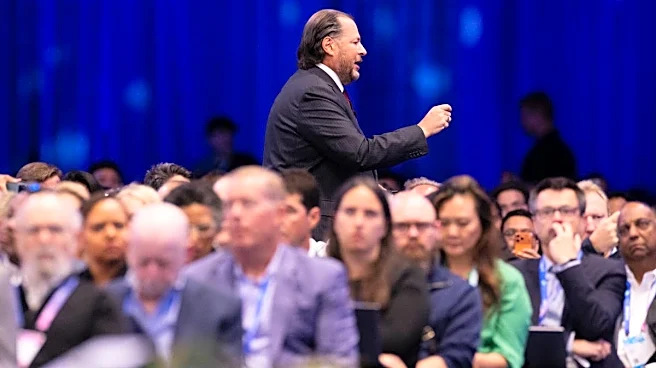
Marc Benioff, CEO of Salesforce, revealed that the company's significant investment in AI startup Anthropic was initially a contingency plan. Salesforce had sought to invest in OpenAI but was prevented due to Microsoft's exclusive relationship with the AI leader.
Microsoft, a competitor to Salesforce in enterprise software, holds approximately 27% of OpenAI and controls commercial access to its models through Azure. This situation prompted Salesforce to pivot its investment strategy towards other AI startups, including Anthropic. Benioff now believes this decision could result in returns of 'tens of billions' of dollars for Salesforce. The investment has evolved into a close business partnership, with Salesforce's Slackbot and other new interfaces now powered by Anthropic's AI model, Claude. Salesforce has invested over $300 million in Anthropic across multiple rounds, starting with an initial $50 million in 2023.
Why It's Important?
This development highlights the intense competition and strategic maneuvering within the rapidly evolving artificial intelligence sector, particularly among major tech companies. Salesforce's inability to invest in OpenAI due to Microsoft's exclusive deal underscores the critical importance of early partnerships and proprietary access to cutting-edge AI technology. The potential 'tens of billions' in returns from Anthropic signifies the immense value and growth potential seen in alternative AI developers. For the U.S. tech industry, this demonstrates how market dynamics, such as exclusive agreements, can redirect investment flows and foster the growth of new players, thereby diversifying the AI landscape. It also illustrates a strategic shift for Salesforce, moving beyond traditional SaaS offerings by deeply integrating AI models like Claude into its core products, such as Slackbot, to enhance functionality and maintain competitiveness in the enterprise software market.
What's Next?
Salesforce's deepened integration with Anthropic's Claude model suggests a continued focus on embedding advanced AI capabilities across its product suite. This partnership is expected to drive further innovation in Salesforce's offerings, particularly in areas like customer relationship management and enterprise communication. The potential for Anthropic to go public, as indicated by Benioff, could provide a significant liquidity event for Salesforce, allowing it to realize substantial returns on its investment. While the timing of an Anthropic IPO remains uncertain, its public debut would establish a market valuation for Salesforce's stake. This move could also influence the broader AI investment landscape, potentially encouraging more capital flow into emerging AI companies as investors seek the next high-growth opportunity outside of the established leaders.
Beyond the Headlines
The narrative of Salesforce's 'Plan B' investment in Anthropic, which now appears poised for massive success, offers a compelling case study in strategic resilience and market adaptation. It suggests that being excluded from a seemingly dominant partnership can sometimes lead to even more lucrative opportunities by forcing companies to explore alternative, undervalued assets. This situation also raises questions about the long-term implications of exclusive AI partnerships on market competition and innovation. While such deals can provide a competitive edge for the involved parties, they might inadvertently foster the growth of rivals by pushing other major players to invest in and develop alternative ecosystems. Ultimately, this scenario could lead to a more diverse and robust AI industry, with multiple strong contenders rather than a single dominant entity, benefiting end-users with a wider array of choices and innovations.