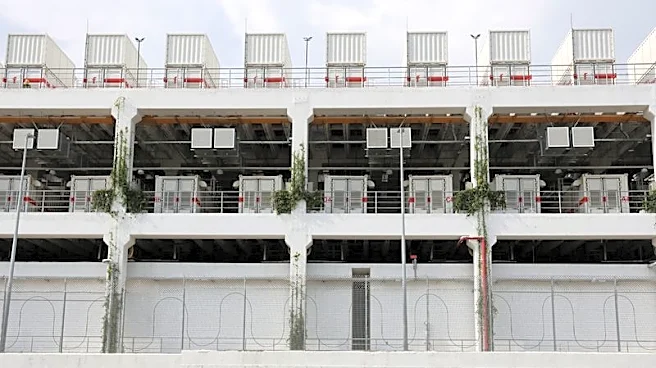








What's Happening?
PwC and Oxford Economics project that global spending on AI data center infrastructure will reach $31.6 trillion by 2050. This cumulative capital expenditure, modeled across 46 countries, is anticipated to dwarf previous infrastructure booms like railways,
electrification, and the internet. The United States is expected to capture a significant portion of this investment, accounting for approximately $15.1 trillion, or 48% of the global total. Other major regions for investment include APAC (driven by China and India) with $8.2 trillion, Europe with $5.6 trillion, the Middle East with $1.1 trillion, and Africa with $255 billion. The annual spending is projected to increase from roughly $800 billion in 2026 to $1.1 trillion by 2030, and further to $1.8 trillion by 2050. A key characteristic of this spending cycle is its compounding nature, unlike previous infrastructure projects that tapered off. Hardware, such as GPUs and servers, has a replacement cycle of 4-6 years, meaning that every dollar spent on construction triggers an estimated $12 in follow-on ICT equipment over the asset's lifetime, creating a continuous demand for upgrades within facilities that have a longer lifespan.
Why It's Important?
This massive projected investment in AI data centers signifies a fundamental shift in global infrastructure priorities, with profound implications for the U.S. economy and its technological leadership. The U.S. securing nearly half of the global spending positions it as a dominant force in the development and deployment of artificial intelligence, potentially fostering significant job creation, technological innovation, and economic growth. This sustained investment will drive demand for high-tech manufacturing, specialized construction, and a skilled workforce in areas like data science, engineering, and cybersecurity. However, the report also highlights potential friction points that could impact the realization of these investments. Power availability is identified as a primary bottleneck, requiring substantial upgrades to energy infrastructure to support the immense power demands of AI data centers. Chip supply chain disruptions could reduce total global investment by nearly 20%, underscoring the importance of resilient and diversified supply chains. Furthermore, local opposition due to concerns about land use, water consumption, and the broader societal impact of AI could delay or block projects, necessitating careful community engagement and policy development.
What's Next?
The trajectory of AI data center spending will be heavily influenced by three key variables: grid policy, semiconductor access, and community approval. Governments and utility providers will need to develop robust grid policies to ensure reliable, affordable, and low-carbon electricity at scale to meet the escalating energy demands of these facilities. Efforts to secure and diversify semiconductor supply chains will be crucial to mitigate the risk of disruptions and ensure the continuous flow of essential hardware. Addressing community concerns through transparent communication, responsible development practices, and potentially offering local benefits will be vital to gain public acceptance and prevent project delays. The continuous hardware replacement cycles mean that the demand for ICT equipment will remain high, driving ongoing innovation and competition among technology providers. The long-term consequence for consumers will likely be sustained pressure on energy infrastructure and, eventually, the subscription pricing of AI-backed services, as the costs of this extensive infrastructure build are passed down.
Beyond the Headlines
The projected scale of AI data center investment goes beyond mere economic figures; it represents a foundational shift in how societies will function and interact with technology. The continuous, compounding nature of this spending, driven by hardware replacement cycles, suggests that AI infrastructure will be a perpetual and evolving entity, unlike past infrastructure projects that had a more defined completion. This raises ethical considerations regarding the environmental impact of such massive energy consumption and the responsible sourcing of materials. The concentration of nearly half of this investment in the U.S. could further solidify its technological dominance, but also raises questions about equitable access to AI capabilities globally. The potential for local opposition highlights a growing societal unease with the rapid expansion of AI, prompting a need for broader public discourse on the ethical, social, and environmental implications of this technological revolution. The report underscores that the most expensive infrastructure build in history is not just underway, but is fundamentally reshaping the future.