



What's Happening?
Avicena, a company specializing in microLED-based optical interconnects, has successfully raised over $100 million in Series C funding. This capital injection is intended to accelerate the commercialization of its LightBundle™ platform, which is designed
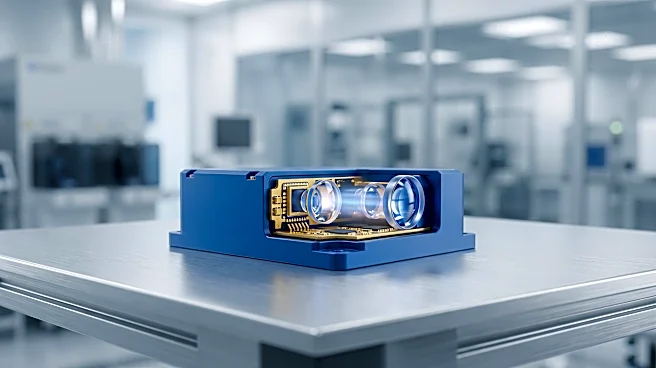
for AI infrastructure. The funding round saw participation from both new and existing investors, including InterVest, Tiger Global, Cerberus Capital Management, SK hynix Ventures, Samsung Catalyst Fund, AMD Ventures, Prosperity7 Ventures, Diamond Edge Ventures (Mitsubishi Chemical Corporation), and Hitachi Ventures. Concurrently, Kevin Pope has been appointed as the new CEO, succeeding Marco Chisari. Pope's background includes guiding multiple companies to successful exits, and he will now lead Avicena's product commercialization efforts. John Dongwoo Ha, Director at InterVest, will also join Avicena's Board of Directors as part of the financing agreement. This funding follows Avicena's recent milestones, including the shipment of 1 Tbps LightBundle evaluation kits in August and the announcement of a connectorized version in September, both aimed at facilitating customer evaluation and addressing practical requirements for system integration.
Why It's Important?
The successful funding round for Avicena is significant for the U.S. technology sector, particularly in the realm of artificial intelligence infrastructure. The LightBundle™ platform addresses critical bottlenecks in data movement within AI systems, where traditional copper links face limitations in reach, routing density, and energy efficiency. As AI systems demand increasing data transfer between accelerators, memory, and switch fabrics, Avicena's technology offers a solution to enhance performance and efficiency. The 'wide-and-slow' architecture of LightBundle, utilizing dense microLED arrays and silicon photodetectors connected through multicore fiber, is designed to provide high bandwidth density, low energy consumption, low latency, and high reliability. This advancement could lead to more powerful and efficient AI data centers, benefiting companies involved in AI development, cloud computing, and data analytics. The investment from a diverse group of venture capital firms and corporate investors underscores the perceived value and potential impact of Avicena's technology on the future of AI infrastructure.
What's Next?
With the new Series C funding, Avicena plans to expand its team, accelerate product development, and scale its engineering capabilities to bring its first product to market next year. The company's focus will be on the practical deployment of microLED optical interconnects in AI infrastructure, addressing the growing demand for efficient data movement. The appointment of Kevin Pope as CEO signals a strategic shift towards commercialization, leveraging his experience in bringing technologies to market. The ongoing evaluation of LightBundle evaluation kits by customers and the development of connectorized versions indicate a clear path towards broader adoption. As Avicena progresses, its technology could become a key component in next-generation AI systems, potentially influencing how data is processed and transferred within large-scale AI deployments. The company's efforts will likely focus on solidifying partnerships and expanding its market reach within the AI and data center industries.
Beyond the Headlines
The development of Avicena's LightBundle™ platform represents a broader trend in the technology industry towards overcoming physical limitations in data transfer, especially as AI workloads become more complex and data-intensive. The shift from traditional copper links to optical interconnects highlights an ongoing innovation cycle driven by the insatiable demand for faster and more efficient computing. This technological evolution has implications beyond just speed; it also addresses energy consumption, which is a growing concern for large data centers and AI operations. By reducing the need for significant data rate conversions and complex signal processing, Avicena's laser-free platform could contribute to more sustainable and cost-effective AI infrastructure. The success of such technologies could also spur further research and development in microLED and optical communication, potentially leading to new applications and advancements in various high-performance computing fields. The investment in Avicena reflects a strategic bet on the future of AI, where efficient data movement is paramount to unlocking its full potential.