








What's Happening?
China has introduced a national blueprint aimed at developing its 'new-type battery sector,' with ambitious goals for industry growth and innovation across the entire industrial chain by 2030. This plan, released under China’s 15th five-year plan for 2026-2030,
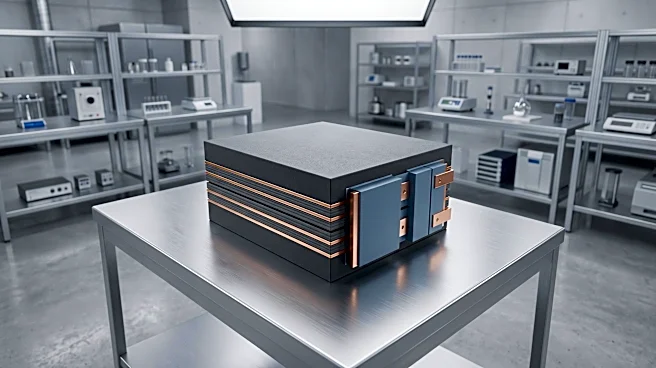
is the country's first dedicated national-level strategy for the battery industry. It defines new-type batteries as high-efficiency devices for storing and converting electrical energy, encompassing lithium, sodium, and flow batteries. Key measures include accelerating technological breakthroughs for industrial-scale production of all-solid-state batteries and establishing a product supply system centered on lithium batteries, complemented by sodium and flow batteries. The government also aims for significant advancements in electrode materials, new electrolytes, and high-end auxiliary materials, alongside progress in developing new battery systems. Official data indicates that China's new-type battery industry's output value exceeded Rmb1 trillion ($149 billion) during the 14th five-year plan (2021-2025).
Why It's Important?
This strategic initiative by China holds significant implications for the global battery market and related industries, including electric vehicles (EVs), energy storage, and robotics. By focusing on multi-chemistry innovation and aiming for large-scale application of advanced battery technologies like all-solid-state batteries, China is positioning itself to dominate future energy storage solutions. This could intensify competition for U.S. battery manufacturers and technology companies, potentially impacting their market share and access to critical materials. The emphasis on improving battery safety, all-climate performance for new energy vehicles, and intellectual property protection suggests a comprehensive approach to solidifying China's leadership in this sector. For the U.S., this development underscores the urgency of investing in domestic battery research, development, and manufacturing to maintain technological competitiveness and reduce reliance on foreign supply chains, particularly in critical sectors like defense and renewable energy.
What's Next?
Over the next few years, China is expected to implement the outlined measures, focusing on accelerating research and development in advanced battery chemistries and scaling up production capabilities. The plan envisions the initial large-scale application of all-solid-state batteries and a cycle life of 15,000 cycles for long-life lithium batteries by 2030. This will likely involve significant government funding, policy support, and collaboration between academic institutions and industry. International reactions may include increased investment in battery technology by other nations, particularly the U.S. and European countries, to counter China's growing dominance. Companies involved in EV manufacturing, grid-scale energy storage, and consumer electronics will closely monitor these developments for potential shifts in supply chains, technological standards, and market dynamics. The focus on intellectual property protection also suggests potential future disputes or collaborations regarding battery patents and innovations.
Beyond the Headlines
Beyond the immediate economic and technological implications, China's national battery plan reflects a broader strategic vision to secure energy independence and leadership in critical future technologies. The push for multi-chemistry innovation, including sodium and flow batteries alongside lithium, indicates a long-term strategy to diversify energy storage solutions and reduce reliance on specific raw materials, which could have geopolitical ramifications. This initiative also highlights the increasing convergence of industrial policy and national security, as control over advanced battery technology becomes crucial for economic competitiveness and military capabilities. The plan's emphasis on improving battery life-cycle traceability also points to a growing focus on sustainability and circular economy principles within China's industrial strategy, which could set new global standards for battery production and recycling. This comprehensive approach could reshape global energy markets and accelerate the transition to renewable energy sources worldwide.