





What's Happening?
FilmInk has published a review of the new 'Street Fighter' film, directed by Kitao Sakurai, noting it as an 'entertaining mess of ideas.' The film focuses on Ryu (Andrew Koji) and Ken (Noah Centineo), exploring their internal struggles. The review praises
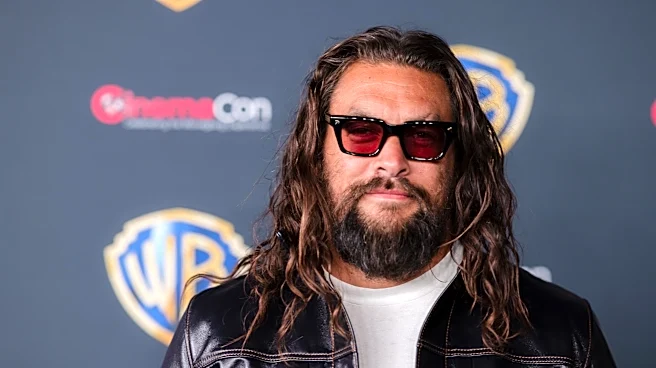
specific performances, including Callina Liang as Chun-Li, David Dastmalchian as M. Bison, and Jason Momoa as Blanka. The action sequences are highlighted as 'gloriously-choreographed' and faithful to the game's iconic moves. However, the review points out significant tonal clashes, particularly between the live-action footage and hand-animated flashback sequences, which are done in the style of the 1994 'Street Fighter II: The Animated Movie.' The film's humor, often relying on 'gay jokes,' is criticized for not fitting with the more earnest dramatic elements. Additionally, the soundtrack is described as an 'absolute mess,' lacking coherence with the film's 1993 period setting and featuring poorly chosen needle drops. Despite these criticisms, the review concludes that the film is a more focused and faithful adaptation than previous attempts, offering a decent live-action experience for fans.
Why It's Important?
This review is important for the entertainment industry as it provides an early critical assessment of a major video game adaptation, a genre that often faces scrutiny from both critics and fans. The film's mixed reception, highlighting strong individual performances and action sequences against a backdrop of tonal inconsistencies and a problematic soundtrack, could influence audience perception and box office performance. For studios, it underscores the challenges of adapting beloved franchises while maintaining narrative coherence and a consistent tone. The criticism regarding the film's humor also reflects evolving standards in comedic content, suggesting that reliance on outdated tropes can detract from a film's overall quality and reception. The comparison to previous 'Street Fighter' adaptations indicates a continuous effort to get these adaptations right, with each new attempt serving as a benchmark for future projects in the genre.
What's Next?
Following this review, the film's performance at the box office and subsequent critical reception from other outlets will be crucial. If the film garners a polarized response, it could lead to discussions within the industry about the best approach to video game adaptations—whether to prioritize fan service, critical acclaim, or a balance of both. The performances praised in the review, particularly those of Andrew Koji, Noah Centineo, Callina Liang, David Dastmalchian, and Jason Momoa, could see increased recognition, potentially leading to more roles for these actors in similar high-profile projects. The director, Kitao Sakurai, may also face scrutiny regarding his stylistic choices, which could influence his future directorial opportunities. The film's ending, described as a 'sequel-bait conclusion,' suggests that the filmmakers anticipate future installments, which will depend heavily on the initial film's commercial and critical success.
Beyond the Headlines
Beyond the immediate critical reception, this 'Street Fighter' adaptation touches upon broader themes in modern cinema, particularly the ongoing struggle to translate video game narratives into compelling cinematic experiences. The film's blend of live-action and animation, while visually ambitious, highlights the difficulty of seamlessly integrating disparate visual styles without disrupting narrative flow. The critique of its humor also reflects a cultural shift, where certain comedic elements once considered acceptable are now viewed as outdated or offensive, prompting filmmakers to be more mindful of their comedic choices. Furthermore, the review implicitly raises questions about the role of nostalgia in adaptations; while aiming for a '90s throwback vibe, the film struggles to discern which elements of that era are worth preserving and which should be updated. This ongoing tension between honoring source material and adapting to contemporary sensibilities remains a significant challenge for franchise filmmaking.