





What's Happening?
CloudNC, a British startup specializing in AI-powered software for manufacturing automation, has successfully raised an additional $20 million in a Series B funding round. This latest investment brings the company's total funding to $128 million. CloudNC, founded
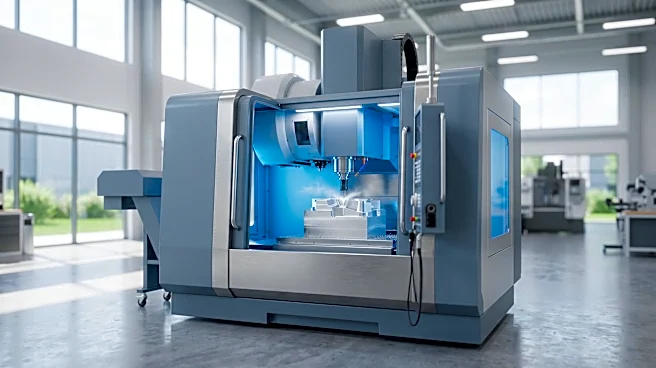
in 2015 by Theo Saville and Chris Emery, aims to enhance the efficiency of Computer Numerical Control (CNC) manufacturing processes through its core product, CAM Assist. CAM Assist is an artificial intelligence-powered software that automates the initial planning stages of machining components. This includes selecting tools, determining machining directions, setting feed parameters, and calculating cutting speeds, ultimately generating code for CNC machines. The software integrates with widely used systems like Autodesk Fusion and Mastercam. The company emphasizes that CAM Assist is designed to augment the productivity of experienced workers rather than replace them, allowing engineers to review, edit, and approve the proposed machining strategies. Approximately 80% of CloudNC's customer base, which includes over 1,000 manufacturing companies, is located in the United States.
Why It's Important?
This funding round is significant for the U.S. manufacturing sector, as a substantial portion of CloudNC's customers are based in the United States. The investment will enable CloudNC to scale its CAM Assist product and expand its adoption, directly impacting American factories. The technology addresses critical challenges faced by the U.S. manufacturing industry, such as the reshoring of manufacturing operations and a persistent shortage of skilled workers. By automating complex programming tasks, CAM Assist allows existing workforces to manage more orders and operate machines more efficiently, thereby increasing productivity without requiring a proportional increase in labor. This can help U.S. manufacturers become more competitive globally, reduce production costs, and accelerate time-to-market for various components used in the automotive, defense, and consumer industries. The ability to quickly estimate costs and risks for new orders, through tools like the upcoming Quote Agent, will further streamline operations and decision-making for U.S. businesses.
What's Next?
With the new $20 million investment, CloudNC plans to expand the deployment of CAM Assist, strengthen its go-to-market operations, and grow in both existing and new markets. The company also intends to develop new products, including 'Quote Agent,' which is scheduled to launch next month. Quote Agent will assist manufacturers in estimating the approximate cost and risks associated with new orders, enabling quicker decisions on project acceptance. CloudNC, which currently employs 80 people, will focus on scaling its solutions to meet the increasing demand for manufacturing automation. The funding round was led by Nimble Ventures, with additional investments from Calculus Venture Capital, Entrepreneur First, and LM Capital, the venture arm of Lockheed Martin. These developments suggest a continued push towards integrating AI and automation into manufacturing processes, with a particular focus on enhancing efficiency and addressing labor challenges in the U.S. industrial landscape.
Beyond the Headlines
The success of CloudNC and the significant investment it has attracted highlight a broader trend in the manufacturing industry: the increasing reliance on artificial intelligence to overcome operational hurdles. The concept of 'reshoring' manufacturing to the United States, driven by geopolitical factors and supply chain vulnerabilities, necessitates innovative solutions to maintain cost-effectiveness and efficiency. AI-powered software like CAM Assist plays a crucial role in this by optimizing production processes and mitigating the impact of skilled labor shortages. This shift could lead to a more resilient and technologically advanced U.S. manufacturing base. Furthermore, the development of tools like Quote Agent indicates a move towards more data-driven decision-making in manufacturing, allowing companies to assess project viability with greater precision. This technological evolution not only impacts economic stakeholders but also raises questions about the future of work in manufacturing, emphasizing the need for upskilling and adaptation among the workforce to collaborate with AI systems.