






What's Happening?
Lumentum Holdings, a San Jose, California-based provider of optical and photonic products, has seen its stock decline by approximately 35% over the past 30 days. This drop, from $896.33 on October 14 to about $580, was primarily driven by the announcement
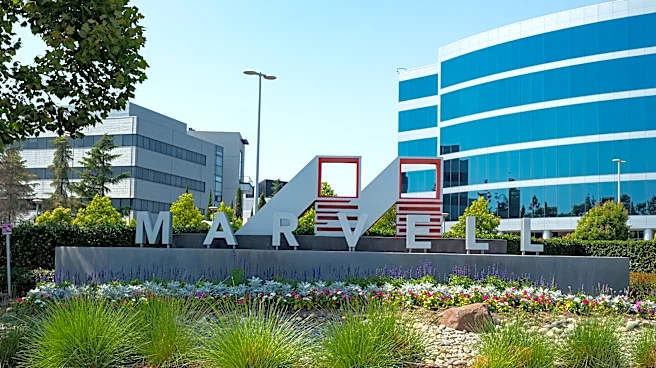
that Marvell Technology would acquire Lumentum in an all-stock transaction valued at approximately $115 billion. Under the terms of the deal, Lumentum shareholders are set to receive 4.5 Marvell shares for each Lumentum share. The fixed exchange ratio means Lumentum's stock performance is now closely tied to Marvell's, which also experienced a significant decline following the announcement. This situation was further exacerbated by a broader semiconductor selloff, accelerated by a weak forecast from Intel. Despite Lumentum's strong fiscal first-quarter revenue of $1.263 billion, up 136.5% year over year, and non-GAAP EPS of $4.57, which beat consensus estimates, the merger news and market rotation out of chip stocks overshadowed these positive results.
Why It's Important?
The proposed acquisition of Lumentum by Marvell Technology, and the subsequent stock declines, highlight significant shifts and uncertainties within the U.S. technology and semiconductor sectors. Lumentum is a key supplier in the AI data-center build-out, with a majority of its revenue tied to cloud and AI infrastructure. Its leadership in indium phosphide (InP) compound-semiconductor manufacturing and differentiated laser technology are critical for next-generation optical connectivity. The decline in both Lumentum and Marvell's stock prices raises questions about investor confidence in large-scale mergers, especially when the acquiring company's equity value exceeds half its market capitalization. This event could influence future M&A activity in the tech industry, potentially making companies more cautious about all-stock deals. Furthermore, the broader semiconductor selloff, partly triggered by Intel's forecast, indicates a potential cooling or re-evaluation of the high-growth expectations previously associated with the chip sector, impacting numerous U.S. tech companies and their investors.
What's Next?
The most critical factor for Lumentum's stock in the coming months will be the progress of the Marvell acquisition. The all-stock nature of the deal means Lumentum's price will continue to track Marvell's share performance until the expected closing in the first half of calendar 2028, pending shareholder and regulatory approvals. Regulatory risks, deal-financing considerations, and any shifts in Marvell's valuation will remain key swing factors. Beyond the merger, investors will monitor Lumentum's execution on its optical roadmap, including the ramp-up of 1.6T transceivers, Optical Circuit Switching (OCS) shipments, and co-packaged optics (CPO)/near-packaged optics (NPO) laser programs. A proposed U.S. ban on certain Chinese optical transceivers could potentially shift demand towards domestic suppliers like Lumentum. Continued strength in AI data-center spending and competitive dynamics with peers such as Coherent and any changes to Nvidia's procurement plans will also influence market sentiment.
Beyond the Headlines
The Lumentum-Marvell situation underscores a deeper trend in the technology sector: the increasing consolidation and strategic maneuvering to capture market share in the rapidly expanding AI and cloud infrastructure space. The reliance on all-stock transactions in such large deals introduces a unique set of risks, as the value of the acquisition becomes directly tied to the market performance of the acquiring company. This can lead to significant volatility and uncertainty for shareholders of both entities, as seen with the recent stock declines. The broader implications extend to the competitive landscape of optical components and semiconductors, where technological leadership in areas like indium phosphide manufacturing and advanced laser components is crucial. The outcome of this merger and the subsequent market reactions could set precedents for how future high-value tech acquisitions are structured and perceived, potentially influencing investor appetite for risk in a sector vital to the U.S. economy's digital transformation.