




What's Happening?
U.S. companies like Physical Intelligence and Skild AI are actively developing technologies aimed at rapidly teaching robots new tasks, mirroring efforts seen in Europe. This pursuit comes as Paris-based startup Bleu Robotics successfully demonstrated
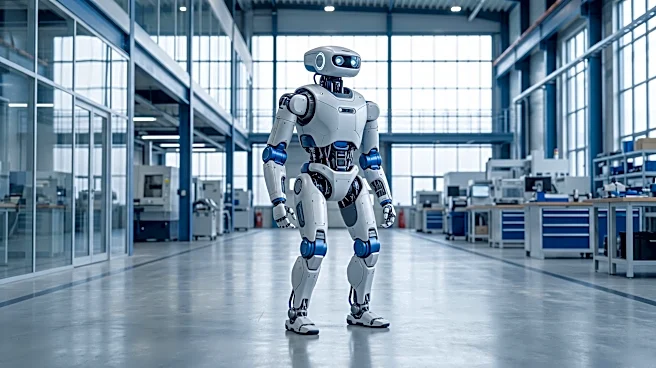
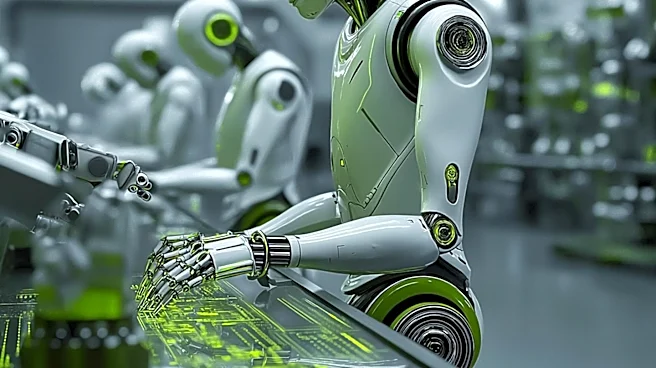
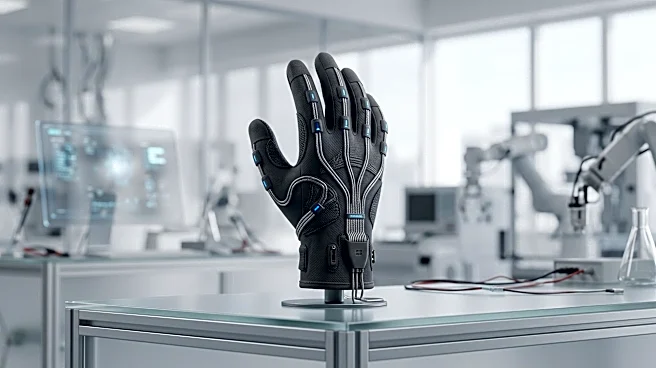
teaching a humanoid robot a factory job in 11 minutes. The robot, deployed at a Novares plant in Spain, packed 206 out of 207 car parts in a 65-minute run. The process involved an engineer steering the robot's arms with a VR joystick to record 12 demonstrations, totaling about 6 minutes of data. Bleu Robotics then trained the AI model on-site in under 5 minutes. This rapid learning capability is seen as a significant advancement, potentially reducing the need for skilled engineers over several months and lowering costs compared to traditional automated cells.
Why It's Important?
The advancements in rapid robot teaching by U.S. and European companies signify a potential shift in manufacturing and industrial automation. For U.S. industries, this technology could lead to increased efficiency, reduced operational costs, and greater flexibility in production lines. The ability to quickly re-task robots could allow manufacturers to adapt more swiftly to changing market demands and product variations. Companies that successfully implement such AI-driven automation could gain a competitive edge, while those that lag might face challenges in productivity and cost-effectiveness. The development also highlights a growing global competition in AI and robotics, with U.S. firms striving to keep pace with or surpass international innovations in this critical technological domain.
What's Next?
The immediate next steps for companies like Bleu Robotics, and by extension, U.S. counterparts, involve moving beyond proof-of-concept stages to full-scale production deployments. This includes conducting extensive tests over longer periods and with larger volumes of parts to ensure reliability, durability, and cost-effectiveness in real-world industrial settings. The focus will be on addressing challenges such as robot downtime, performance over full shifts, and the ability to handle unexpected variations in tasks. The success of these further tests will determine the widespread adoption of such rapid robot teaching methods across various manufacturing sectors, potentially leading to significant investments in AI and robotics infrastructure.
Beyond the Headlines
The rapid advancement in AI-driven robot teaching raises deeper implications for the future of labor and the economy. While promising increased productivity, it also brings into focus the potential for job displacement in sectors traditionally reliant on manual labor. The ethical considerations of human-robot collaboration and the need for workforce retraining programs will become increasingly critical. Furthermore, the intellectual property and competitive landscape surrounding these AI algorithms for robot learning will likely intensify, leading to strategic acquisitions and partnerships among technology firms. The long-term societal impact will depend on how effectively governments, industries, and educational institutions adapt to these technological shifts, ensuring a just transition for workers and fostering innovation responsibly.