




What's Happening?
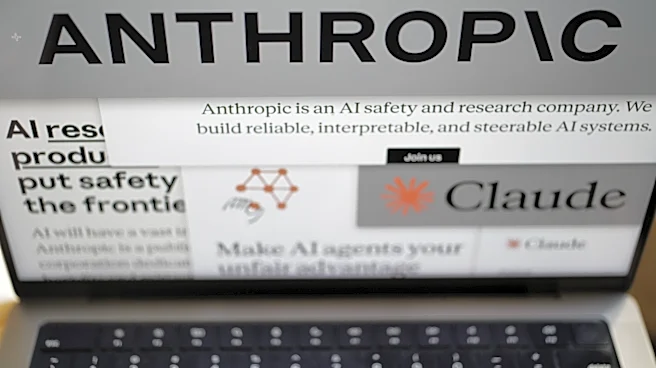
Yasmin Razavi, a partner at Spark Capital, has been recognized for her pivotal role in leading Spark Capital's initial institutional investment in Anthropic in January 2023. This recognition comes as Anthropic recently held its historic Initial Public
Offering (IPO). According to Clay Fisher, another partner at Spark Capital, Razavi authored two internal memos advocating for investment in Anthropic, highlighting the potential of scaling laws in AI and the vast market for intelligence. At the time, Anthropic had no public product or revenue, and many venture capitalists were hesitant to invest. Spark Capital's investment, led by Razavi, amounted to $75 million as part of a $450 million round, valuing Anthropic at $4.6 billion. Dealroom reports that Spark Capital has since invested a total of $777 million across six funding rounds, resulting in an approximate 18x return, or roughly $14 billion, representing about 1% of Anthropic.
Why It's Important?
This event underscores the significant impact of early-stage venture capital decisions on the trajectory of emerging technology companies and the financial landscape. Yasmin Razavi's foresight in identifying the potential of Anthropic, particularly its reliance on scaling laws in AI development, demonstrates the critical role of individual investors in shaping the future of industries. Her success, leading to her inclusion on the Forbes Midas List, highlights the substantial financial rewards for venture capitalists who take calculated risks on innovative, unproven technologies. For the broader U.S. technology sector, this success story could encourage further investment in AI research and development, potentially accelerating advancements and fostering a more competitive environment. It also illustrates how strategic early investments can lead to massive returns, influencing investment strategies across the venture capital community.
What's Next?
The success of Anthropic's IPO and the substantial returns for early investors like Spark Capital are likely to intensify the focus on AI startups within the venture capital community. This could lead to increased funding for companies exploring advanced AI models and scaling laws, potentially driving further innovation in the sector. However, the ongoing copyright lawsuits against Anthropic, which were not a focus during the IPO but are noted in Anthropic's S1 filing, represent a potential future challenge. The outcomes of these legal battles, particularly how courts interpret AI training as 'fair use,' could significantly impact the operational models and legal frameworks for AI development in the U.S. and beyond. The broader implications for intellectual property rights in the age of AI will be closely watched by legal experts and technology companies alike.
Beyond the Headlines
The narrative surrounding Anthropic's IPO and Spark Capital's early investment extends beyond mere financial gains, touching upon the philosophical and ethical dimensions of artificial intelligence. The emphasis on 'scaling laws' as a foundational principle for AI development suggests a deeper understanding of how intelligence can be engineered and improved. This approach raises questions about the nature of intelligence itself and the potential for AI to surpass human capabilities in various domains. Furthermore, the legal challenges concerning copyright and AI training highlight the evolving ethical and legal landscape that accompanies rapid technological advancement. The decisions made in these cases will not only affect Anthropic but could set precedents for the entire AI industry, influencing how data is used, how intellectual property is protected, and ultimately, the societal integration of advanced AI systems. This development underscores the ongoing tension between innovation and regulation in the tech sector.