







What's Happening?
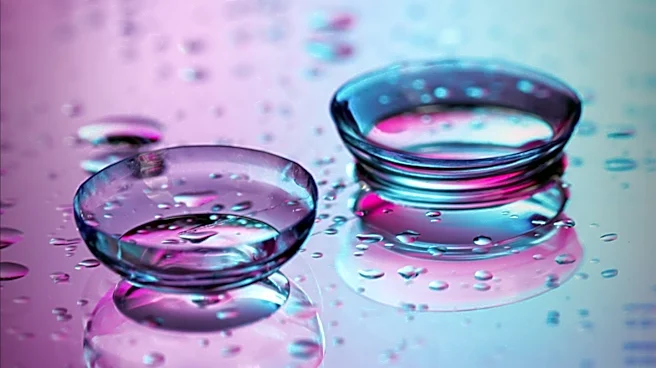
Researchers Jung-Hyun Choi and Byoung-Ki Cho from Dankook University in South Korea have developed a new type of contact lens that can self-repair when exposed to ultraviolet (UV) light. The innovation involves a hydrogel material with a disulfide cross-linker,
which allows the lenses to heal scratches that occur during regular use. This self-healing capability is achieved by the sulfur-to-sulfur bonds in the disulfide cross-linker, which can reconnect under UV light, restoring up to 90% of the lens's structural stability. The lenses also demonstrate excellent water retention and scratch resistance, potentially reducing the frequency of scratches. This development could lead to more durable and longer-lasting contact lenses, reducing waste and cost for users.
Why It's Important?
The introduction of self-healing contact lenses could significantly impact the contact lens industry by reducing the need for frequent replacements due to scratches and damage. This innovation not only promises cost savings for consumers but also addresses environmental concerns by decreasing waste. Additionally, the enhanced durability and scratch resistance could improve ocular health by minimizing the risk of infections associated with scratched lenses. The ability to use existing UV light cleaners for both cleaning and repairing lenses could further simplify lens maintenance for users. This advancement represents a step forward in ophthalmic device technology, potentially setting a new standard for contact lens durability and performance.
What's Next?
Before these self-healing contact lenses can be made commercially available, further safety testing is required to ensure they are safe for consumer use. Researchers will need to conduct additional studies to confirm the long-term effects of the materials used and their interaction with the human eye. If successful, these lenses could be introduced to the market, offering a new option for contact lens wearers seeking more durable and cost-effective solutions. The development may also inspire further research into self-healing materials for other applications, potentially leading to broader innovations in consumer products.