






What's Happening?
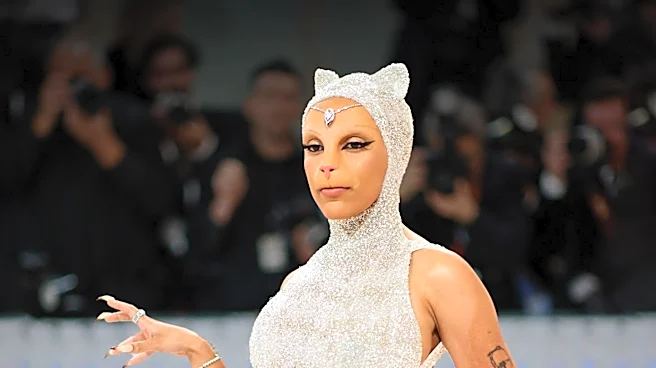
Kim Petras has publicly stated that she was not 'snubbed' by the Grammys, despite her third studio album, 'Detour,' receiving no nominations for the 2027 awards. Fans expressed disappointment on social media platform X, suggesting she was overlooked.
However, Petras responded by saying she 'just left the industry' and made the music out of passion. She further explained that campaigning for Grammy consideration is costly, mentioning that she struggled to afford mixing and mastering for her album. Petras previously won a Grammy in 2023 for Best Pop Duo/Group Performance for 'Unholy' with Sam Smith, where she acknowledged transgender pioneers in her acceptance speech. She also expressed support for fellow artists underscores and Tinashe, who received their first nominations in the Best Dance/Electronic Recording category.
Why It's Important?
Petras's comments highlight the financial barriers and industry pressures faced by artists, particularly those outside the mainstream or without significant label backing. Her decision to step back from the 'nomination days' and focus on creating music for its own sake could influence other independent artists or those feeling disillusioned by the awards system. This perspective challenges the traditional view of success in the music industry, where Grammy nominations are often seen as a crucial benchmark. It also brings attention to the often-unseen costs associated with awards campaigns, which can be prohibitive for many musicians. Her support for other artists like underscores and Tinashe also demonstrates a sense of community within the music scene, particularly for emerging talents in specific genres.
What's Next?
It is likely that Kim Petras will continue to release music independently, prioritizing artistic expression over awards recognition. Her stance may encourage a broader conversation within the music industry about the accessibility and fairness of awards processes, potentially leading to discussions about financial support for artists seeking nominations. Other artists might be inspired to follow a similar path, focusing on direct fan engagement and creative freedom rather than the traditional industry accolades. The success of artists like underscores and Tinashe, whom Petras publicly supported, could also be seen as a testament to the evolving landscape of music recognition, where new talents can emerge and gain traction outside of established pathways.
Beyond the Headlines
Petras's candid remarks about the financial burden of Grammy campaigns shed light on a systemic issue within the music industry: the significant cost associated with gaining recognition. This goes beyond just recording and production, extending to promotional efforts and awards lobbying. Her statement, 'My nomination days r over,' could be interpreted as a critique of an industry that often prioritizes commercial viability and extensive campaigning over artistic merit, especially for artists who may not have the financial resources of major labels. This situation raises questions about equity and inclusion in prestigious awards, suggesting that the playing field might not be level for all artists, regardless of their talent or the quality of their work. It also underscores a potential shift in how artists define success, moving away from traditional accolades towards more personal and authentic creative journeys.