





What's Happening?
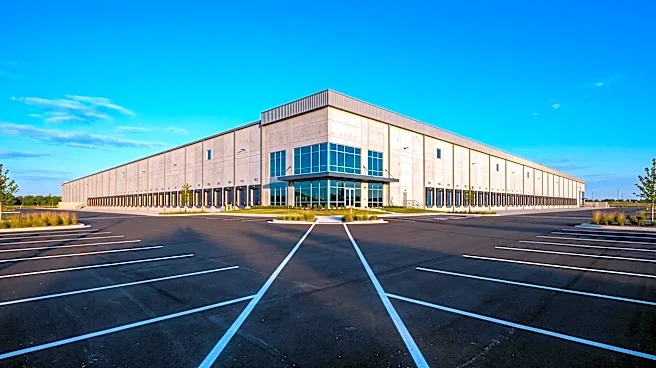
Cushman & Wakefield's National Industrial Advisory Group recently represented Scannell Properties in the sale of 820 Crossing, a 335,004-square-foot distribution center located at 5301 Denton Highway in Haltom City, within the North Fort Worth industrial
submarket of Dallas-Fort Worth. The transaction involved Washington Capital Management, acting on behalf of its institutional clients, as the buyer. The property, which spans 26.7 acres, is fully leased, indicating strong demand for industrial space in the region. The Cushman & Wakefield team that represented the seller included Jim Carpenter, Jud Clements, Robby Rieke, and Emily Brandt. This sale highlights continued activity and investment in the industrial real estate sector, particularly in key logistical hubs like the Dallas-Fort Worth area. The distribution center's full occupancy underscores its strategic value and the robust nature of the industrial market.
Why It's Important?
This sale is important as it reflects the ongoing strength and investor confidence in the U.S. industrial real estate market, particularly in major logistical corridors such as Dallas-Fort Worth. The full occupancy of the 335,004-square-foot distribution center at 820 Crossing signals a healthy demand for warehousing and logistics facilities, which are critical components of the national supply chain. For institutional investors like Washington Capital Management, acquiring fully leased properties offers stable income streams and long-term asset appreciation, making such investments attractive in the current economic climate. The involvement of Cushman & Wakefield, a leading global commercial real estate services firm, in facilitating this significant transaction further emphasizes the professional expertise and market liquidity available for large-scale industrial assets. This trend of robust industrial property sales supports job creation in logistics and distribution, contributes to local tax bases, and reinforces the strategic importance of well-located and fully operational distribution centers for businesses seeking efficient supply chain operations across the country.
What's Next?
The successful sale of 820 Crossing suggests continued investor interest in industrial properties, particularly those with high occupancy rates and strategic locations. Washington Capital Management's acquisition on behalf of institutional clients indicates a long-term investment strategy, likely focusing on stable returns from the fully leased distribution center. This transaction may encourage other property owners in the North Fort Worth industrial submarket to consider similar sales, potentially leading to further consolidation or new investment opportunities in the region. For Cushman & Wakefield, this successful representation reinforces its position as a key player in industrial real estate advisory, potentially attracting more clients seeking to capitalize on the strong market. The ongoing demand for distribution centers is expected to drive further development and investment in logistics infrastructure, as e-commerce and supply chain optimization remain critical for businesses nationwide.
Beyond the Headlines
Beyond the immediate transaction, this sale underscores a broader economic shift towards strengthening supply chain resilience and efficiency. The consistent demand for large, fully leased distribution centers reflects businesses' efforts to optimize their logistics networks in response to evolving consumer behaviors and global economic dynamics. The strategic location of properties like 820 Crossing in major transportation hubs such as Dallas-Fort Worth is crucial for rapid distribution across the U.S., highlighting the critical role of infrastructure in supporting economic growth. Furthermore, the involvement of institutional investors in such assets points to a long-term view on the value of industrial real estate as a stable and essential asset class, potentially influencing future urban planning and development policies to support logistical needs. This trend also has implications for labor markets, as the operation of these large facilities requires a significant workforce, impacting local employment and economic development.