





What's Happening?
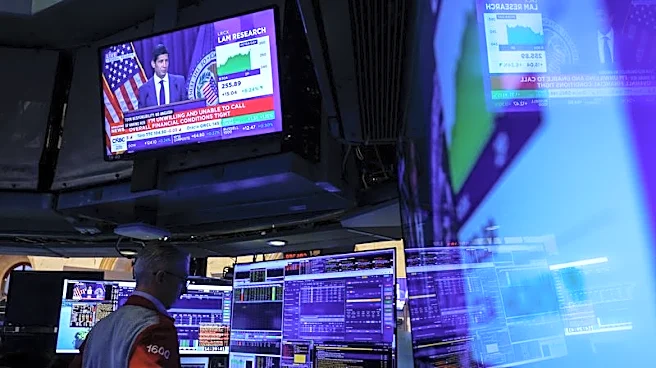
Intel's recent weak outlook, citing declining PC demand and rising component costs, has triggered a significant sell-off across the semiconductor market. Intel's shares plunged nearly 30% on October 30, leading to broader declines in the Philadelphia
Semiconductor Index, with AMD dropping approximately 11% and Nvidia falling over 4%. Intel's client computing division, which accounts for about half of its revenue, saw a 5% year-over-year decrease to $8.1 billion, with management expecting a further 20% sequential decline in the current quarter. The company anticipates the PC market weakness to persist through at least the first half of 2027. This forecast has prompted investors to reassess the sustainability of semiconductor demand, the financial implications of the artificial intelligence (AI) buildout, and the high valuations of chip stocks. The market reaction indicates a concern that even strong demand in AI accelerators and data centers may not fully offset weaknesses in traditional computing segments, leading to a more selective investment approach within the sector.
Why It's Important?
This market reaction is significant because it signals a potential shift in investor sentiment regarding the semiconductor industry's growth trajectory, particularly concerning the AI boom. While AI infrastructure investment has driven substantial growth for many chip companies, Intel's warning highlights the potential for economic realities to temper these expectations. The interconnected nature of the semiconductor supply chain means that a slowdown in one major segment, like PCs, can ripple through equipment makers, memory companies, and designers. Investors are now scrutinizing whether the massive capital expenditure required for AI infrastructure by cloud providers and data center operators will be justified by the revenue generated from AI services. This situation creates a 'two-speed' market, where advanced data center hardware may continue to expand rapidly, while consumer-facing segments face pressure. The challenge for investors is to determine if growth in the strongest categories can compensate for weaknesses elsewhere, demanding a more nuanced analysis of individual companies rather than treating all chip stocks as a single trade.
What's Next?
The immediate focus will be on upcoming earnings reports from other major semiconductor players, including AMD, Nvidia, memory manufacturers, semiconductor equipment companies, and PC makers. Investors will closely monitor management commentary for insights into order trends, inventory levels, capital-spending plans, and customer purchasing behavior. If multiple companies report delayed orders or rising inventories, the current sell-off could intensify. Conversely, if other businesses maintain strong guidance, the market may begin to differentiate between Intel's specific challenges and the broader AI opportunity. Traders will also be watching price action, as sharp declines can create oversold conditions, but this does not automatically imply undervaluation. The industry will need to provide clearer evidence that future growth can support current market expectations, potentially leading to a period of increased selectivity and scrutiny of company fundamentals, revenue mix, balance sheets, and competitive advantages.
Beyond the Headlines
Beyond the immediate financial implications, Intel's situation underscores a deeper tension between the rapid technological advancement driven by AI and the cyclical realities of the broader electronics market. The AI boom has fueled unprecedented demand for specialized hardware, but the cost of this buildout and its eventual return on investment are now under intense scrutiny. This development could lead to a re-evaluation of investment strategies within the tech sector, potentially favoring companies with more diversified revenue streams or those less exposed to the volatile consumer electronics market. Furthermore, the increased cost of memory components, partly driven by AI demand, could eventually impact PC manufacturers and consumers, potentially dampening demand for everyday devices. This scenario highlights the complex interplay of supply chain dynamics, technological innovation, and market demand, suggesting a period where the semiconductor industry must navigate both unprecedented opportunities and significant economic headwinds.