






What's Happening?
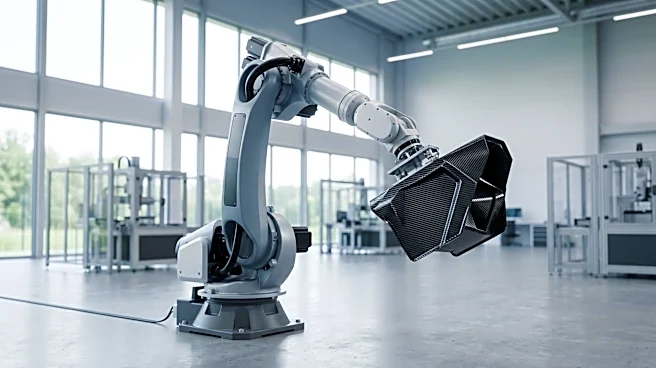
Helicon Industries, a Los Angeles-based startup, has emerged from stealth with $16 million in seed funding, led by AlleyCorp, to automate high-volume manufacturing of advanced composites, starting with carbon fiber. The company aims to reduce composite manufacturing lead
times from six months or more to just two weeks. Co-founder and CTO Edmundo Sanz-Gadea, along with co-founder and CEO Alex Niehaus, founded Helicon with the goal of 'reindustrializing the West' by addressing the challenges of slow, labor-intensive, and difficult-to-automate composite production. Helicon is developing automated manufacturing systems and processes that focus on ease of automation and faster cycle times, aiming for under 15 minutes per part, compared to hours for traditional methods. The company is also working with material suppliers to support larger production volumes and is preparing to move into a 36,000 sq. ft. facility in Torrance, California, to scale up production. Helicon sees applications beyond aerospace and defense, including robotics, logistics, and maritime industries.
Why It's Important?
The automation of high-volume composites manufacturing by Helicon Industries is a critical development for U.S. industrial competitiveness and supply chain resilience. Currently, advanced composites like carbon fiber offer superior strength-to-weight ratios but are hampered by inefficient and manual production processes, often relying on overseas suppliers. By significantly reducing lead times and automating production, Helicon can enable domestic manufacturing of high-performance components at scale. This is particularly important for defense programs, where secure and rapid domestic supply chains are crucial, and for emerging industries like robotics, which require lightweight, high-performance structures in larger volumes. The ability to produce composites more efficiently and cost-effectively could lead to a broader adoption of these materials, driving innovation in product design and performance across various sectors, from aerospace to consumer goods. This initiative also supports the broader goal of 'reindustrializing the West' by bringing advanced manufacturing capabilities back to the U.S.
What's Next?
Helicon Industries is gearing up for production in its new 36,000 sq. ft. facility in Torrance, California. The company will continue to hire across various engineering and operational roles to build out its manufacturing capabilities. A key focus will be on developing and implementing automated processes that achieve the targeted sub-15-minute cycle times for composite parts. Helicon will also work towards obtaining the necessary certifications to serve demanding aerospace and defense programs, while simultaneously exploring and securing partnerships with customers in robotics, logistics, and maritime sectors. The company plans to expand its collaborations with material suppliers to ensure a steady and high-volume supply of carbon fiber and other composite materials. The long-term ambition is to establish the manufacturing capacity to produce advanced composites at a true industrial scale, moving beyond specialized, low-volume production.
Beyond the Headlines
Helicon's efforts to automate composites manufacturing highlight a broader trend towards advanced manufacturing and the integration of robotics and automation into traditional industrial processes. This shift has significant implications for the future of work, requiring a workforce with new skills in robotics, software, and advanced materials. The 'reindustrialization' goal also touches upon national security and economic sovereignty, as countries seek to reduce reliance on foreign supply chains for critical components. The widespread adoption of automated composite manufacturing could lead to a new era of product design, where the limitations of traditional materials and manufacturing processes are overcome, enabling lighter, stronger, and more efficient products across almost every industry. However, the environmental impact of increased composite production and the challenges of recycling these materials will also need to be addressed as the industry scales.