







What's Happening?
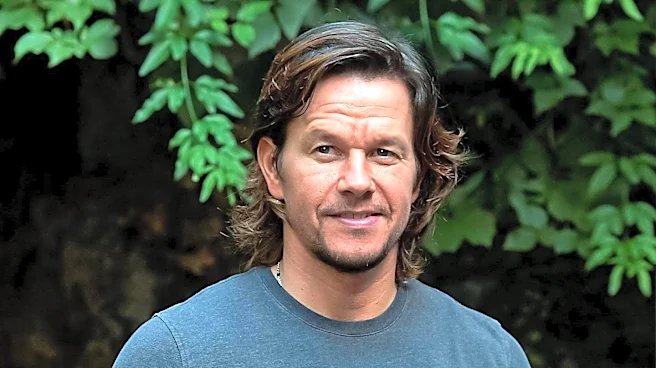
Actor Mark Wahlberg has unequivocally stated his disinterest in the 2001 science fiction film 'Planet of the Apes,' directed by Tim Burton. Wahlberg, who starred in the movie, expressed in a 2005 interview with PopEntertainment that he would neither remake
the film nor watch it again. The movie, which was a reinterpretation of Pierre Boulle's novel and the 1968 film, garnered $362 million globally against a $100 million budget, a performance considered honest but ultimately disappointing. Despite praise for its makeup, sets, and overall aesthetics, the film's screenplay was widely criticized for being confusing and lacking depth. Critics noted that it failed to capture the political and philosophical dimensions of its predecessors, focusing instead on spectacle. Wahlberg's character was also perceived as underdeveloped, with the ape characters, particularly General Thade played by Tim Roth, being more memorable.
Why It's Important?
Wahlberg's strong stance on the 2001 'Planet of the Apes' film highlights a significant moment in his career trajectory and the broader film industry's approach to remakes. His decision to distance himself from the project, stating a desire to work only with preferred directors and on films he genuinely wanted to see, marked a shift towards more selective and critically acclaimed roles. This approach proved successful, as he received an Oscar nomination for Best Supporting Actor the following year for his performance in Martin Scorsese's 'The Departed.' This illustrates how an actor's public perception and career choices can be heavily influenced by past projects, especially those that receive mixed critical reception. For the film industry, it underscores the challenges and risks associated with reinterpreting beloved classics, particularly when the new version fails to resonate with audiences or critics on a deeper thematic level, as was the case with Burton's 'Planet of the Apes' compared to the original's satirical depth.
What's Next?
Following the 2001 film, the 'Planet of the Apes' franchise saw a successful reboot with 'Rise of the Planet of the Apes' in 2011, directed by Rupert Wyatt, and subsequent installments like 'Dawn of the Planet of the Apes' and 'War for the Planet of the Apes,' directed by Matt Reeves. Wes Ball is set to direct 'Kingdom of the Planet of the Apes' in 2024, continuing the saga. This demonstrates the enduring appeal of the 'Planet of the Apes' narrative and the industry's willingness to revisit and re-imagine franchises despite previous critical missteps. For Mark Wahlberg, his career continued to flourish with diverse roles, indicating that his candid assessment of past projects did not hinder his professional growth. The availability of the entire saga on Disney+ suggests ongoing commercial interest in the franchise, allowing new generations to discover its various iterations.
Beyond the Headlines
The critical reception of Tim Burton's 'Planet of the Apes' and Mark Wahlberg's subsequent comments delve into the complex relationship between artistic vision, commercial pressures, and audience expectations in Hollywood. The film's struggle to balance Burton's distinctive gothic aesthetic with the demands of a major blockbuster, leading to a perceived lack of 'soul,' raises questions about creative autonomy within large studio productions. The comparison to the 1968 original, which was lauded for its satirical commentary on nuclear war, militarism, and human evolution, highlights a recurring challenge in remakes: the difficulty of replicating or updating the profound thematic resonance of a classic while also delivering a fresh and engaging narrative. Wahlberg's pivot towards more personally fulfilling projects after this experience reflects a broader trend among established actors to prioritize artistic integrity and personal connection to their work over purely commercial ventures, especially after achieving a certain level of success.