





What's Happening?
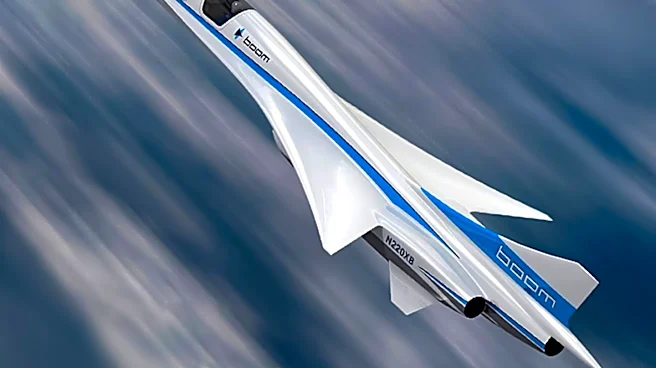
United Airlines CEO Scott Kirby has stated that Boom Supersonic's Overture airliner will not meet its targeted 2029 entry-into-service date. Speaking on the Office Hours: Business Edition podcast, Kirby indicated that the development and certification
process for the supersonic jet would require more time than Boom Supersonic has projected. United Airlines has an agreement to purchase 15 Overture aircraft, with options for an additional 35, contingent on the aircraft meeting specific safety, operating, and sustainability requirements. While acknowledging the significant hurdles, Kirby also praised Boom founder and CEO Blake Scholl and the company's expansion into turbines for data centers. Boom Supersonic had previously outlined plans for a 2025 rollout, a first flight in 2026, and passenger service in 2029. The company recently announced the completion of its first prototype turbine core, Sprint Core, with initial firing expected by the end of November 2026.
Why It's Important?
This prediction from a major airline CEO like Scott Kirby carries significant weight for the future of supersonic commercial travel and the aerospace industry. A delay in the Overture's service entry could impact United Airlines' fleet modernization plans and its strategy to reintroduce supersonic flights. It also highlights the inherent challenges and complexities involved in developing and certifying advanced aviation technology. For Boom Supersonic, a delay could affect investor confidence, its competitive position, and its ability to secure further orders. The success of the Overture program is crucial for the revival of supersonic passenger travel, which has been absent since the Concorde's retirement in 2003. The development of the Overture's engine, Symphony, and its ground-based counterpart, Superpower, also represents a significant technological undertaking with implications for both aviation and energy sectors.
What's Next?
Boom Supersonic will likely need to address Kirby's comments and provide updated timelines for the Overture's development and certification. The company's ongoing testing of the Sprint Core, with initial firing anticipated soon, is a critical step in the engine development process. The FAA is also working on finalizing new noise-based operating standards for civil supersonic flight over land by mid-2027, which is essential for the Overture's operational viability in the U.S. United Airlines will continue to monitor the Overture's progress, and any significant delays could lead to adjustments in its long-term fleet strategy. The broader aerospace industry will be watching closely to see how Boom Supersonic navigates these challenges and whether it can ultimately deliver on its ambitious goals for supersonic commercial flight.
Beyond the Headlines
The skepticism expressed by Scott Kirby underscores the immense technical, regulatory, and financial hurdles involved in bringing a new supersonic aircraft to market. The history of supersonic commercial flight, marked by the Concorde's eventual retirement, serves as a cautionary tale. Boom Supersonic's strategy of developing a ground-based turbine (Superpower) alongside the aircraft engine (Symphony) to generate revenue and inform engine development is an innovative approach to mitigate risk and accelerate progress. However, the integration of these two distinct applications presents its own set of engineering and business challenges. The success or failure of the Overture program will not only determine the future of Boom Supersonic but also influence the appetite for investment in other ambitious aerospace projects aimed at pushing the boundaries of commercial aviation.